Ch 20 - Capture a Baseline

Comment

Ch 20 - Capture a Baseline

You will never know how far you’ve come unless you know where you started from. 

I can’t tell you how many people over the years have come to me after 6 weeks of hard work discouraged at their results. They’ll say something like, “I’m so disappointed in my progress.” 

If you ever say this to me, be prepared: I will argue with you. This is horseshit and impossible. Nobody ever works hard for 6 weeks without seeing remarkable progress. Nobody. So, you either didn’t do the work, or you skipped one of the most important steps when beginning a health journey. You skipped the step where we capture baseline data. In other words, you didn’t do any measuring, weighing or pictures. You didn’t document where you started out. 

Big mistake on two levels. On one level, you’ll see amazing progress with your body and soul. Others will remark at how great you are looking. They’ll ask, how far have you come? Maybe they are hoping for inspiration. Maybe knowing would continue to inspire you, but you won’t know. That’s frustrating. Not knowing will always be a bitter regret. 

On the other level, you might be very hard on yourself. Most of us are our own worst critics. Perhaps nobody said or noticed anything about your progress. Maybe you don’t really see it. Maybe you see it, but disbelieve. After 6 hard weeks of plowing you might want to know if another 6 weeks is worth the effort. It is, and you should do it anyway, but maybe you want backup. You won’t have it. This is even more frustrating. A lot of folks give up at this point, which is sad since they were already making incredible progress. 


Comment

Ch 21 - How to Capture Baseline Data

Comment

Ch 21 - How to Capture Baseline Data

Measuring, Weighing and Documenting


To capture a baseline, RWND has devised a system of Measuring & Weighing yourself.

The scale alone doesn’t tell the whole story. Neither does measuring or photographic proof, but all of these methods combined (it’s in the APP) are a powerful gauge of progress and success, which is incomparable. When combined with regular logging and analysis of similar workouts, these tools are unparalleled for charting success.


Suggestions for Measuring and Weighing

  • Measure weekly for those seeking dramatic changes.

  • Measure monthly for those seeking to maintain health & appearance.

  • Measure at roughly the same time of day. (Early mornings are best)

  • Take note of clothing worn and wear the same clothes each time.

  • Use the same tape measure.

  • Use the same scale.

  • Use the same person/trainer to measure. 

    • Each person/trainer will have their own slightly different technique and pull the tape differently. 

  • Measure to the closest quarter of an inch.

  • Discuss and compare measurements immediately.

  • Save to a place which CANNOT be lost.

  • NEVER EVER CHEAT.


Weighing Yourself

Don’t get hung up on this step. If you and the scale have a bad relationship, ditch it. No prob. You don’t need to do this step. If you are cool with the scale and weighing yourself doesn’t trigger emotions of low self-esteem, go for it! 

We prefer capturing a 7 day average over evaluating any immediate result taken from a scale.To obtain a 7 day average follow these steps:

1- Record weight daily for 7 days

2 - Add the 7 days together

3 - Divide by 7

Example: 

Step 1 - Record weight for 7 days

wt. day 1 - 181
wt. day 2 - 179

wt. day 3 - 178

wt. day 4 - 181
wt. day 5 - 183

wt. day 6 - 180

wt. day 7 - 179

Step 2 - Add 7 days together = 1,261

Step 3 - Divide by 7 = 180.14

We encourage you to keep meticulous track of your progress by using scales (if you can stay emotionally healthy while doing so). It is easier and better information to keep track on the same scale, as there can be small variances between different scales.


Additional Recommendations for Capturing Scale Data

  • Use digital scales with a “ZEROING” function.

  • Use the same scale daily.

  • Measure at roughly the same time each day.

    • First thing in morning

    • After bathroom

    • Stripped

  • If weighing cannot be done early in the morning you must take note of the following:

    • Shoes/no shoes

    • Clothes worn

    • Recent food/beverage intake

    • Recent exercise

Capturing Circumference Measurement Data

Consistency is KEY here. There are many methods for capturing measurement data. None quite as important as consistency. Being able to measure at the same spot using the same tension on the tape, time after time, will provide you with more valuable data.

When measuring, it pays to be bold. Just get in there and do it. Do it often. Those who develop a quick and efficient technique will inspire the most confidence in your numbers. It takes practice to develop good technique. 

Recommendations for Capturing Circumference Measurement Data

  • Use 60” flexible tape with numbers on both sides

  • Find and mark the same sites

  • Measure 1 side of the body only.

    • Right side is preferable.

  • Using a 3 pull average is better than 1

    • Large anomalies in measurement are indications of measurement error.

  • Default to the narrowest, and/or widest points.

  • If there are several widest points default to the “highest wide.”

  • Wear the same clothes as last measurement.

    • Where possible, measure bare skin.

    • Even the smallest fabrics will alter measurements dramatically

  • You must wait at least 1 hour after a workout before measuring.

    • Exercising causes blood to pool in the extremities. It alters measurements.

    • Exercising causes skin to swell (from sweat).

Recommended Measurement Sites and Suggestions

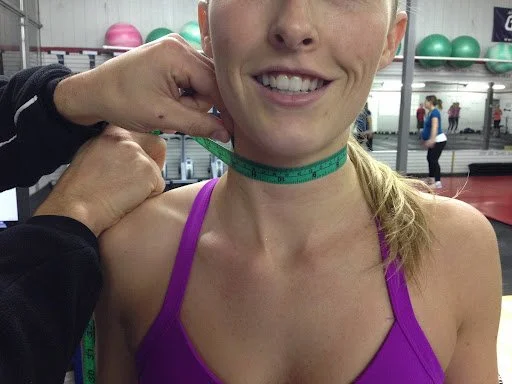
Neck

  • Measure the circumference of the middle portion of the neck.

  • Neck is a “litmus test” measurement. It is comparable to the upper arm.


.

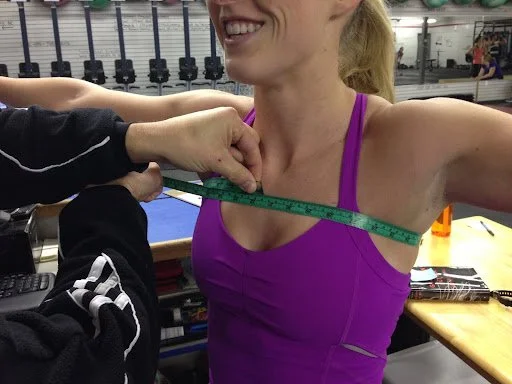
Chest

  • Arms should remain straight out from the sides.

  • Take a medium breath in and hold.

  • Use the slide technique using a slight upward pull.


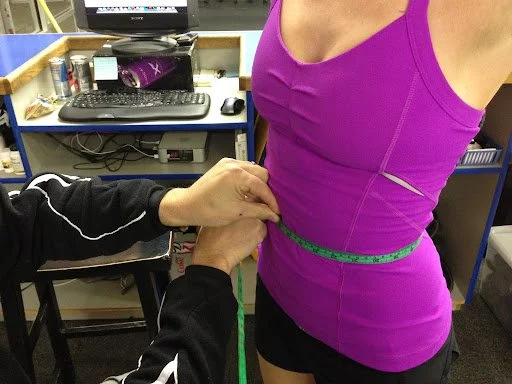
Waist 

  • Measure the narrowest point below the rib cage and above the hips.

  • If no narrow point measure widest

  • Measure the “highest wide.”

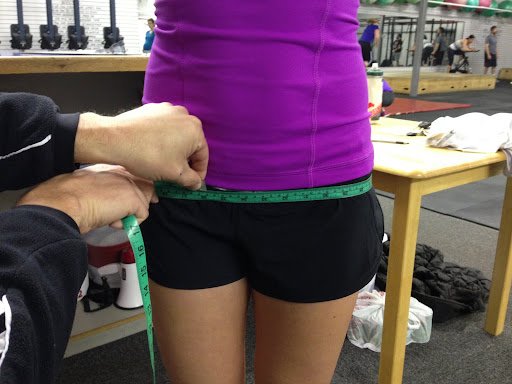
Hips

  • Measure the widest point of your hips.

  • Understand hips are 3D. The widest point may be on a spectrum from front to back.

  • If there are two widest points, measure the “highest wide.”

  • Hips measurements should occur above the groin.

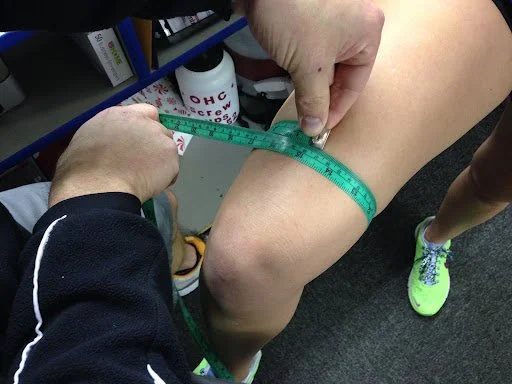
Thigh

  • Stand without weight on the measured leg.

  • Bend knee to 90 deg.

  • Measure 4” from the top, of the back, of the kneecap.

  • Measure consistently with the entire tape above the mark you made.

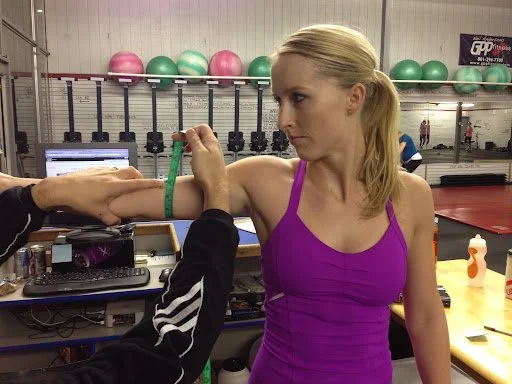
Upper Arm

  • Measure arm extended from the side, palm up.

  • Measure 2” from the crease of the elbow.

    • Many people have several creases. Measure from the highest one for consistency.

  • Measure consistently with the entire tape above the mark you made.

  • Compare to the neck.

    • Changes made in the arm are usually comparable to those made in the neck.If they are not, you should suspect measurement error.


Capture Video or Photos

It is much easier these days to capture video or photographic data, but there are pitfalls. Remember, consistency is key to comparing data. It’s cool because the RWND app has this feature built in. Use it. If you don’t have it, get it. If you can’t get it, here are some general guidelines for capturing consistent data. Use the following suggestions: 

  • Note the background. Make sure it is the same, or as close to the same brightness, color and texture as possible. 

  • Less texture in your background is better. 

  • Brighter colored backgrounds are better.

  • Note the distance between you and your background. It should be the same. Closer to the background is better. 

  • Note the distance between you and the camera. It should be the same. Closer to the camera, while still fitting in your entire body is preferable. 

  • Note the camera angle. Be sure to take photos from the same angle (up, down, side to side).

  • Note the aspect ratio. We prefer taller aspects to wider ones.

  • The sun or a bright light should be shining from the front. 

  • Brighter illumination is better. However, warmer “golden hour lights” make you look better. You see the muscle definition better!

  • Use the same poses and facial expressions. 

  • Capture photos/video from front, side and back. 

  • Dress in the same clothes.

  • Darker clothes are better.

  • Tighter fitting clothes are better.

  • Fewer clothes are better. 

Comment

Section 2 - Exercise

Comment

Section 2 - Exercise

This is the part where we talk about what exercise is, how to exercise, how to build a proper workout, how to warm-up, how intense we need to workout and other important stuff.  

I know you want to skip right to the routine. It’s cool if you do. Just download the APP right now and begin. While you are getting in shape, keep in mind there is a LOT to know about health and fitness at our age. Please read it, learn it and apply.


Comment

Ch 22 - RWND Approach to Fitness

Comment

Ch 22 - RWND Approach to Fitness

Sequential Training 

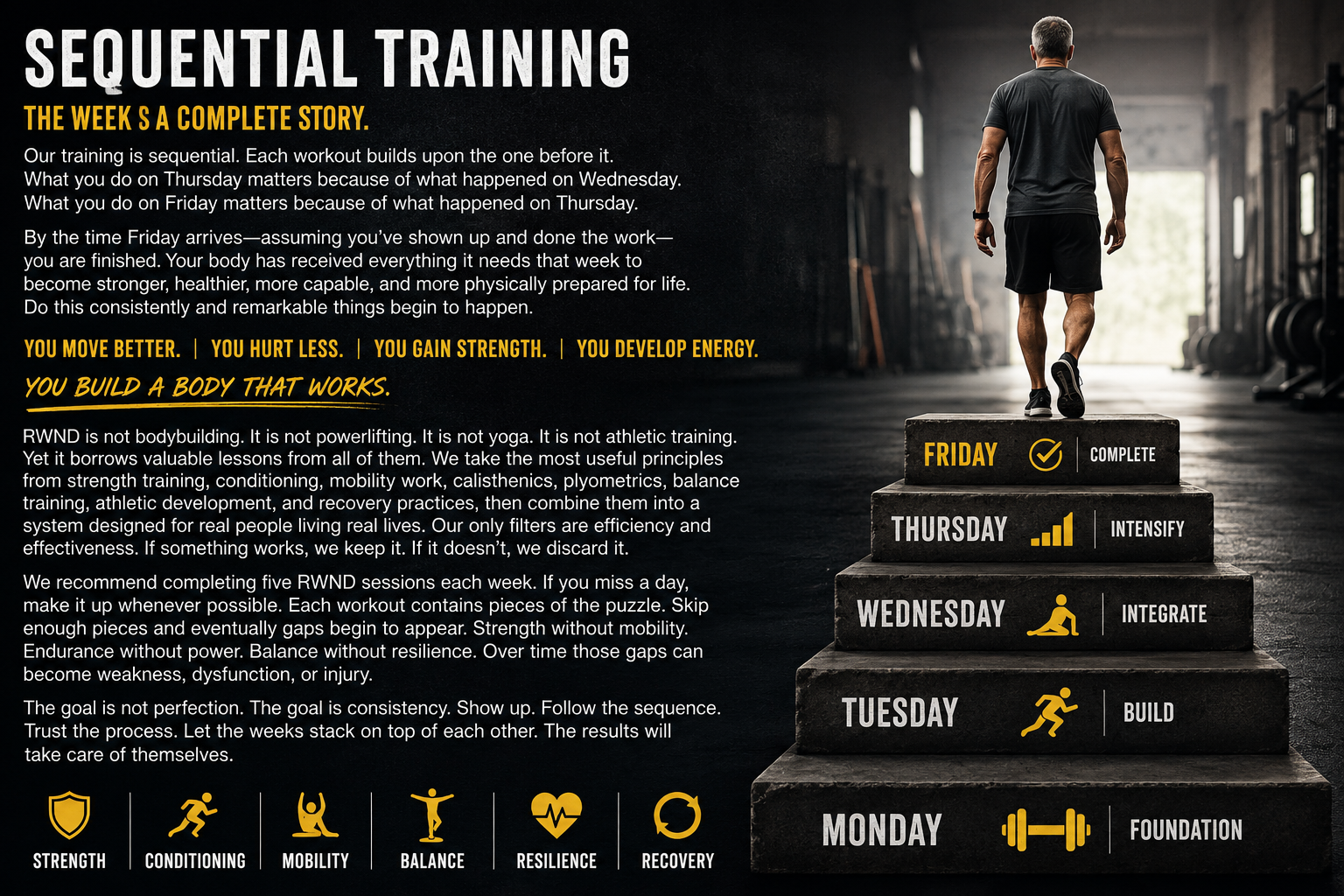
Most workout programs treat each day as a separate event. Monday is chest day. Tuesday is legs. Wednesday is cardio. Miss a day and nobody thinks much about it. RWND doesn't work that way.

Our training is sequential. Each workout builds upon the one before it. What you do on Thursday matters because of what happened on Wednesday. What you do on Friday matters because of what happened on Thursday. The week is a complete story, with each workout contributing something important to your overall health, strength, movement, balance, conditioning, resilience, and recovery. Nothing is random. Nothing is included simply to make you sweat, suffer, or spend more time in the gym.

By the time Friday arrives—assuming you've shown up and done the work—you are finished. Your body has received everything it needs that week to become stronger, healthier, more capable, and more physically prepared for life. Do this consistently and remarkable things begin to happen. You move better. You hurt less. You gain strength. You develop energy. Most importantly, you build a body that works.

RWND is not bodybuilding. It is not powerlifting. It is not yoga. It is not athletic training. Yet it borrows valuable lessons from all of them. We take the most useful principles from strength training, conditioning, mobility work, calisthenics, plyometrics, balance training, athletic development, and recovery practices, then combine them into a system designed for real people living real lives. Our only filters are efficiency and effectiveness. If something works, we keep it. If it doesn't, we discard it.

I recommend completing five RWND sessions each week. If you miss a day, make it up whenever possible. Each workout contains pieces of the puzzle. Skip enough pieces and eventually gaps begin to appear. Strength without mobility. Endurance without power. Balance without resilience. Over time those gaps can become weakness, dysfunction, or injury.

The goal is not perfection. The goal is consistency. Show up. Follow the sequence. Trust the process. Let the weeks stack on top of each other. The results will take care of themselves.

Comment

Ch 23 - RWND Programming Method

Comment

Ch 23 - RWND Programming Method

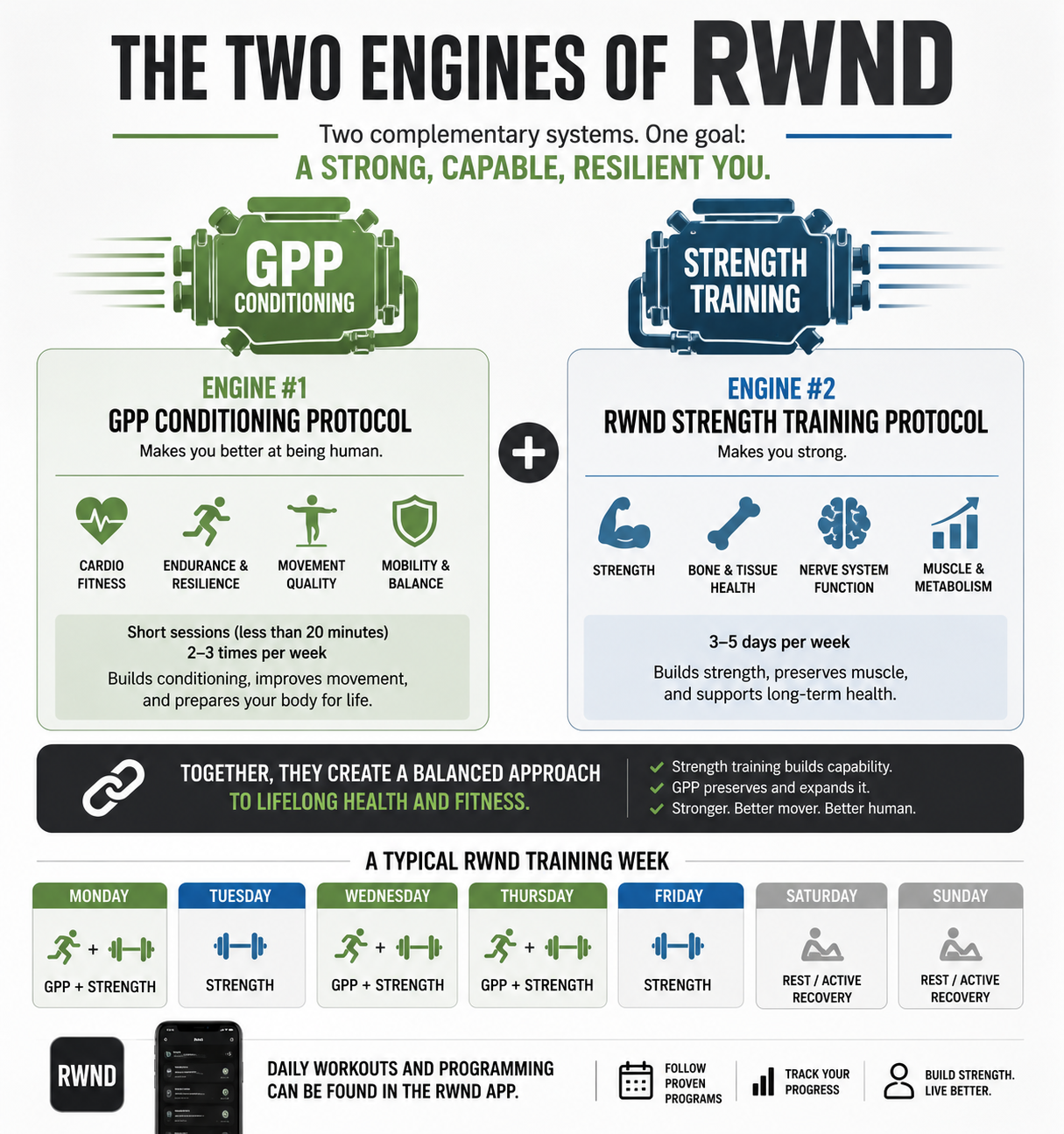
The Two Engines of RWND

RWND programming consists of two complementary systems working together to build a healthy, capable body.

  1. GPP Conditioning Protocol

  2. RWND Strength Training Protocol.

Think of them as the two engines that drive your results. One develops broad physical capability. The other develops strength. Together they create a body that is strong, conditioned, resilient, and capable of handling the demands of everyday life.

GPP Protocol


GPP stands for General Physical Preparedness. Simply put, its job is to make you better at being human. GPP develops many of the qualities people gradually lose as they age, including cardiovascular fitness, muscular endurance, balance, coordination, flexibility, movement quality, and resilience. While strength training tends to focus on specific movement patterns and muscles, GPP focuses on the body as a complete system.

A typical GPP session lasts less than twenty minutes and is performed two or three times per week. GPP helps keep the body balanced by exposing it to a wide variety of movement patterns. Throughout a week of training it addresses pushing, pulling, squatting, hinging, core stability, and cardiovascular conditioning. This variety helps reduce boredom, improve coordination, correct imbalances, and maintain athleticism. GPP can also be used as a warm-up before training or as active recovery between harder strength sessions.

Most importantly, GPP serves as your primary source of conditioning and cardiovascular health. It keeps you moving well, recovering well, and physically prepared for the demands of daily life. It helps strengthen the smaller muscles and connective tissues often overlooked by traditional strength programs while improving movement quality and overall work capacity.


RWND Strength Training Protocol

If GPP's job is to make you capable, the job of RWND Strength Training is to make you strong. The RWND Strength Training Protocol is specifically designed to produce maximum strength while minimizing wear and tear on the body. Unlike many traditional programs that rely on excessive volume, failure training, and endless sets, RWND strength training focuses on efficiency. We seek the greatest possible adaptation from the smallest effective dose of exercise.

This approach improves muscular strength, muscle density, coordination, bone density, tendon strength, ligament integrity, nervous system function, and overall physical capacity while reducing unnecessary stress on joints and connective tissues. The goal is not to do more work. The goal is to get more results from less work.

RWND Strength Training is typically performed three to five days per week depending on the specific protocol being followed. Its primary role is to stimulate strength, preserve muscle mass, improve bone health, increase metabolism, and maintain the physical capabilities required for a healthy and independent life.

Many fitness programs focus on conditioning or strength. RWND does both. Strength training builds capability. GPP preserves and expands it. Strength training helps you become stronger. GPP helps you move better, recover better, and function better. Neither is complete without the other.

Together they create a balanced approach to lifelong health and fitness.

A typical RWND training week might look something like this:

Monday: GPP and Strength Training.

Tuesday: Strength Training.

Wednesday: GPP and Strength Training.

Thursday: GPP and Strength Training.

Friday: Strength Training.

Daily workouts and programming can be found in the RWND App.

Comment

Ch 24 - What is the Perfect Warm-Up?

Comment

Ch 24 - What is the Perfect Warm-Up?

If you attend enough fitness conferences, you'll eventually hear experts arguing about the perfect warm-up.

One group advocates foam rollers. Another prefers dynamic mobility drills. Others insist on elaborate movement screens, activation exercises, corrective protocols, breathing techniques, stretching sequences, or highly specific routines that seem to take longer than the workout itself.

The problem is that nobody can agree on which warm-up is best.

For decades, warm-ups were believed to dramatically reduce the risk of injury during exercise. Yet despite thousands of studies and countless recommendations, researchers still struggle to identify a single superior method. Some approaches show modest benefits. Others show none at all. Most produce remarkably similar outcomes.

This mirrors what I've observed over more than three decades of coaching.

I've seen people spend twenty minutes meticulously warming up before suffering an injury during a relatively modest effort. We've also seen people walk into the gym, perform a few quick ramp-up sets, and complete enormous physical efforts without issue or injury.

This doesn't mean warm-ups are useless.

Far from it.

It simply means that many of the reasons people believe they need elaborate warm-up routines may not be as important as they think.

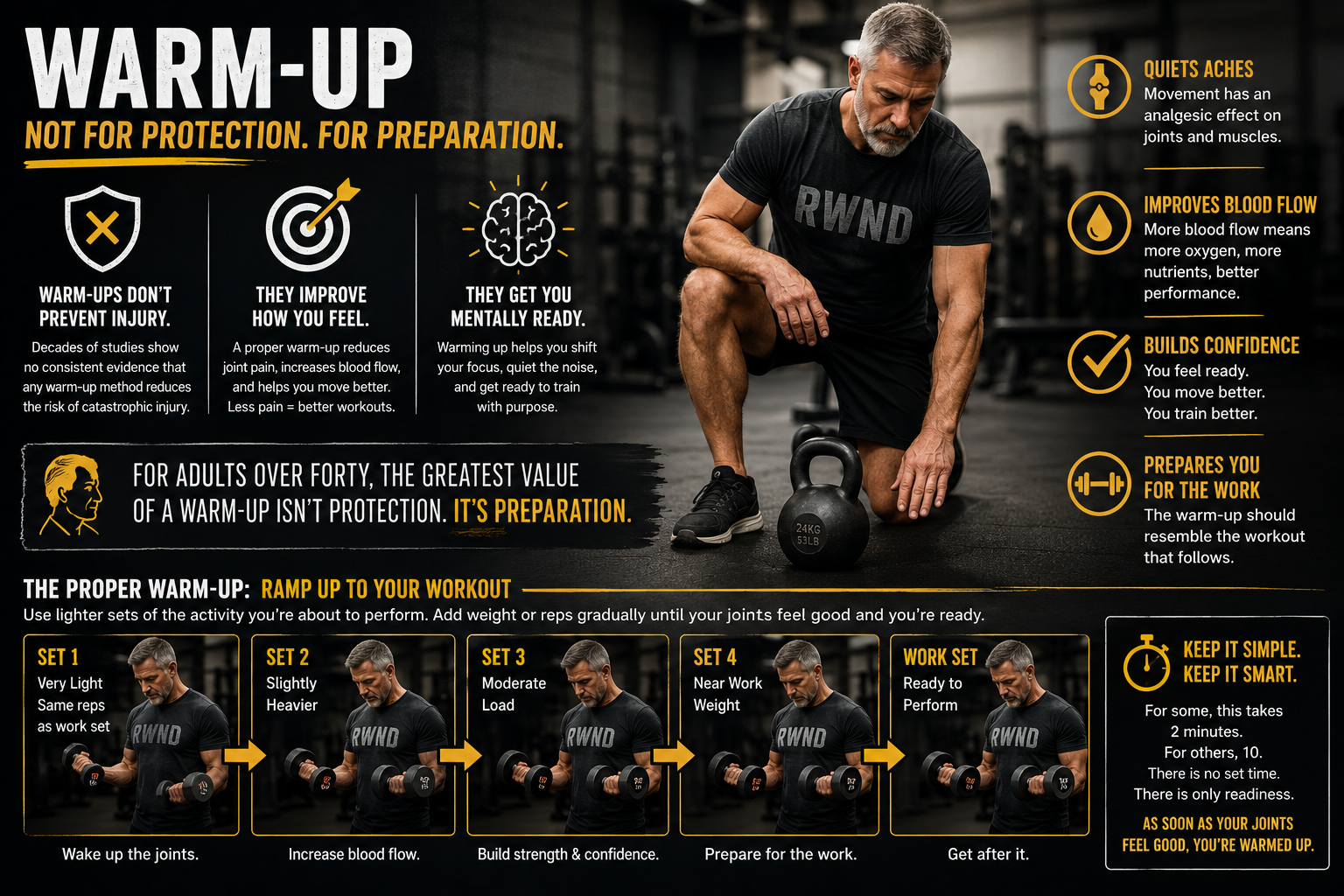
For adults over forty, the greatest value of a warm-up isn't protection. It's preparation.

Most of us arrive at the gym carrying something. A stiff shoulder. An achy knee. A cranky back. Tight hips. Sore feet. The accumulated mileage of a life well lived.

A good warm-up helps quiet those complaints.

Movement has a powerful analgesic effect. As blood flow increases and joints begin moving through comfortable ranges of motion, aches and pains often diminish. The body loosens up. The mind becomes focused. The workout becomes more productive.

That's why we warm up.

Not because we believe a magical sequence of exercises will make us injury-proof.

Not because we enjoy spending twenty minutes preparing for ten minutes of training.

We warm up because we feel better when we do.

And when we feel better, we train better.

The Proper Warm-Up

The solution to the warm-up question is remarkably simple.

Perform several lighter sets, rounds, or repetitions of the activity you're about to do.

If heavy biceps curls are scheduled, begin with a very light weight and perform the same movement. Add a little weight. Perform another set. Add a little more weight. Continue until your joints feel comfortable and your body feels ready.

That's it.

The warm-up should resemble the workout.

The warm-up should prepare you for the task ahead.

The warm-up should end the moment you feel ready.

For some people this takes two minutes. For others it takes ten or more. The goal is not to follow a complicated ritual. The goal is to arrive at the workout feeling comfortable, confident, and prepared.

As soon as your joints feel good and your movement feels smooth, your warm-up is complete.

Get after it.

Comment

Ch 25 - Push, Pull, Squat and Core

Comment

Ch 25 - Push, Pull, Squat and Core

The Four Cardinal Movements

Before we can discuss how to train the body, we must first understand how the body was designed to move.

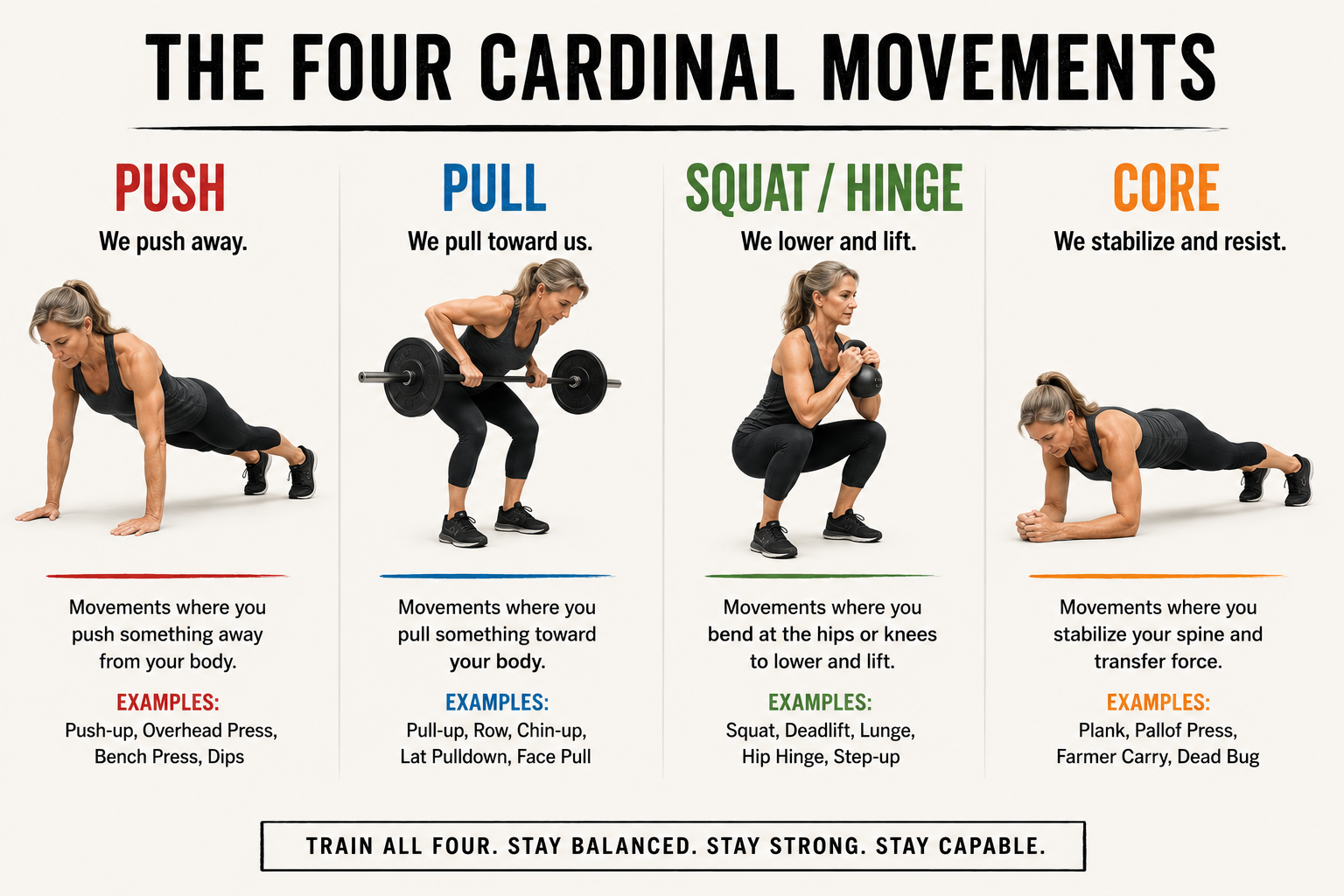
Human beings are remarkably complex creatures, but our movement patterns are surprisingly simple. Nearly every physical task we perform can be reduced to four fundamental actions: we push, we pull, we squat and hinge, and we stabilize through the core. These are the Four Cardinal Movements.

Every time you stand from a chair, place a box on a shelf, carry groceries, pull open a door, climb a hill, pick up a child, or get yourself off the ground, you are using one or more of these movement patterns. Your body was built to do them. And therein lies an important truth: the fact that your body can do something is often a clue that it needs to do it.

A body capable of pulling needs to pull. A body capable of squatting needs to squat. A body capable of pushing needs to push. A body capable of stabilizing itself needs to challenge its core. Ignoring any of these movement patterns for long enough eventually creates a gap in your physical capability.

Pulling will never replace pushing. Pushing will never replace squatting. Core work will never replace conditioning. And no amount of running can replace the strength-building benefits of a properly performed squat, push, pull, and core training program. This is where many exercise programs fall short.

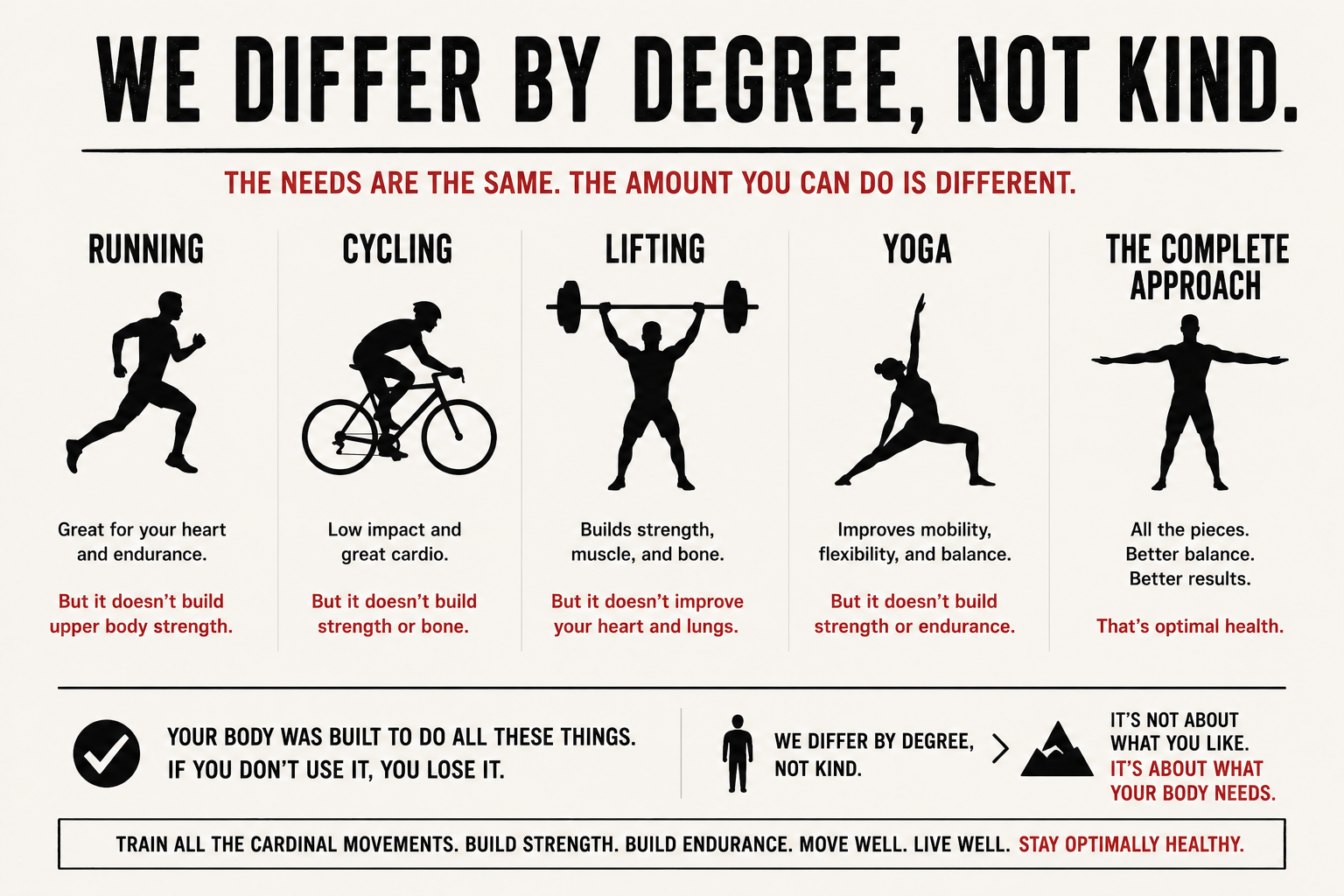
Runners often run but rarely lift. Cyclists pedal thousands of miles but seldom challenge their upper bodies. Yogis become wonderfully mobile but may neglect strength and conditioning. Weightlifters build tremendous strength while sometimes overlooking mobility and endurance. Each activity provides valuable benefits, but none provides all of them.

Health requires a broader approach.

The goal is not to become exceptional at one movement pattern while ignoring the others. The goal is to remain capable across all of them. The body thrives on variety, balance, and challenge. It was not designed to perform one movement repeatedly while neglecting all others. To become healthy, resilient, and physically capable, all four cardinal movements must be trained in balanced and comprehensive ways.

There may come a day when injury, age, pain, or limitation makes one of these movements difficult or impossible. If that happens, don't abandon the pattern altogether. Find the closest version your body will allow and continue practicing it. A partial squat is still a squat. An assisted pull is still a pull. A modified push is still a push. The body rewards effort far more than perfection.

Everything else in fitness is simply a variation on these themes. Master the Four Cardinal Movements and you will possess the foundation upon which nearly every aspect of health, fitness, strength, and physical independence is built.

Comment

Ch 26 - We Differ by Degree, NOT Kind

Comment

Ch 26 - We Differ by Degree, NOT Kind

“Frankly, Neil, I prefer a brisk morning walk and some light stretching to your stuff. Your stuff is hard and makes me sore. I like my stuff better.”

- Dumb people


I love your thoughts on this. Seriously, nothing appeals to me more than the notion we can become optimally healthy without doing all the shit we don’t like. Burpees? Fuck those things. Eating right? Nah. I just prefer some light walking, easy stretching, and twinkie munching. I hope more than anything else in life, these things are attainable. 

They aren’t.

The physical needs of all humans are the same. Preferences be damned. We all need to do the same things to become and stay “Optimally Healthy.” Understanding how your body works is the key element in developing a complete, balanced physique. It’ll also save you from wasting time and effort. 


The fact your body has the ability to do a thing MANDATES participation in that thing. 


This is true much to the chagrin of many a skinny runner, a fat bench presser and weak yogi. Nope, none of these participate in complete, balanced fitness routines. Most runners don’t use their upper bodies comprehensively. Neither do they perform strength movements for their lower bodies. Running alone leaves a lot of healthy components of exercise unaddressed. This makes running alone (and biking, walking, swimming) poor exercise. By that same mark, people who weight lift without doing cardiovascular exercise are also off the path when it comes to optimal health training. Yoga, I love you. I hate to pick on you, but your techniques stimulate neither the health benefits of strength training NOR cardiovascular exercise. 

What running, cycling, swimming, lifting & yoga done alone fail to realize is that not only are they poor choices for exercising, they are also inefficient. To get the MOST out of running, you’d need to do a LOT of running. You actually have to spend hours and hours running. If you were doing a balanced fitness method (RWND) you’d need to do a lot less of it. That’s the secret of proper exercise. When designed right, it’s efficient and effective. It takes less time to complete, not more and more. 

Your body will reward you with positive change and healthy improvements only with proper stimuli. But when you don’t give it stimulus it doesn’t just NOT reward you, it becomes diseased and unhealthy. IOW your cute little walk won’t give you the needed benefits and health of lifting weights. And you have to be careful because all unhealthy results are systemic. Letting one part of your body go to hell is usually quickly followed by many others. 

You can’t develop muscle, bone, and connective tissue in a place you aren’t stimulating. And your body hates homeostasis. You are always either becoming stronger or weaker. If you aren’t stimulating growth you are shrinking. When muscles shrink, connective tissues shrink. When connective tissues shrink, joints become less viable. When this happens you become weaker and less capable. In other words, if you don’t use it, you really do lose it! 

The needs of all humans differ by degree, not kind. All humans need the same kinds of exercise to become and stay “Optimally Healthy” - preferences be damned. It’s the same for young and old. The only difference is the degree of difficulty you can apply at different times of your life.

Comment

Ch 27 - Understanding Intensity

Comment

Ch 27 - Understanding Intensity

Learning the major movement patterns (push, pull, squat, hinge, and core) is a great start. But knowing how to move is only half the equation.

To get the most from your training, you also need to understand how hard to move.

Every activity you perform falls somewhere on an intensity spectrum. Walk around the block and you're working at a low intensity. Sprint up a hill and you're working at a high intensity. Most things fall somewhere in between.

Your body has three primary energy systems that support these different levels of effort.


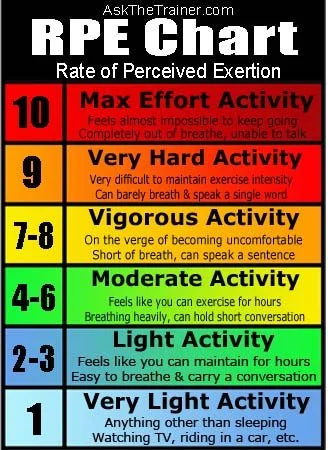
Low Intensity (RPE 3-6)

The Oxidative System

This is the engine that powers walking, hiking, easy cycling, yard work, and other longer-duration activities.

Benefits include:

  • Improved cardiovascular health

  • Better endurance

  • Increased recovery capacity

  • Reduced risk of heart disease and stroke


Moderate Intensity (RPE 6-8)

The Glycolytic System

This system takes over when the effort becomes challenging but sustainable. Think of a hard conditioning circuit, a set of kettlebell swings, or carrying something heavy for a minute or two.

Benefits include:

  • Improved muscular endurance

  • Stronger bones, muscles, and connective tissue

  • Better work capacity

  • Increased metabolic fitness


High Intensity (RPE 9-10)

The ATP-PCr System

This is your body's "turbocharger." It fuels short bursts of maximum effort such as heavy lifting, jumping, sprinting, or explosive athletic movements.

Benefits include:

  • Increased strength and power

  • Improved nervous system efficiency

  • Better athletic performance

  • Preservation of fast-twitch muscle fibers as we age


Why This Matters

Many people spend all their time in only one of these zones. Some walk but never challenge their muscles. Others lift weights but neglect cardiovascular conditioning.

Neither approach is complete.

Each intensity level produces unique adaptations that the others cannot fully replace. If your goal is optimal health, longevity, and capability, you need exposure to all three.

The formula is surprisingly simple:

  • Move your body through the major movement patterns.

  • Train at different intensity levels.

  • Allow adequate recovery.

  • Stay consistent.

Do that week after week, month after month, and you'll build a body that is stronger, healthier, and more capable for life.


Comment

Ch 28 - Resting Between Sets

Comment

Ch 28 - Resting Between Sets

Most people think a workout is all about effort.

It's not.

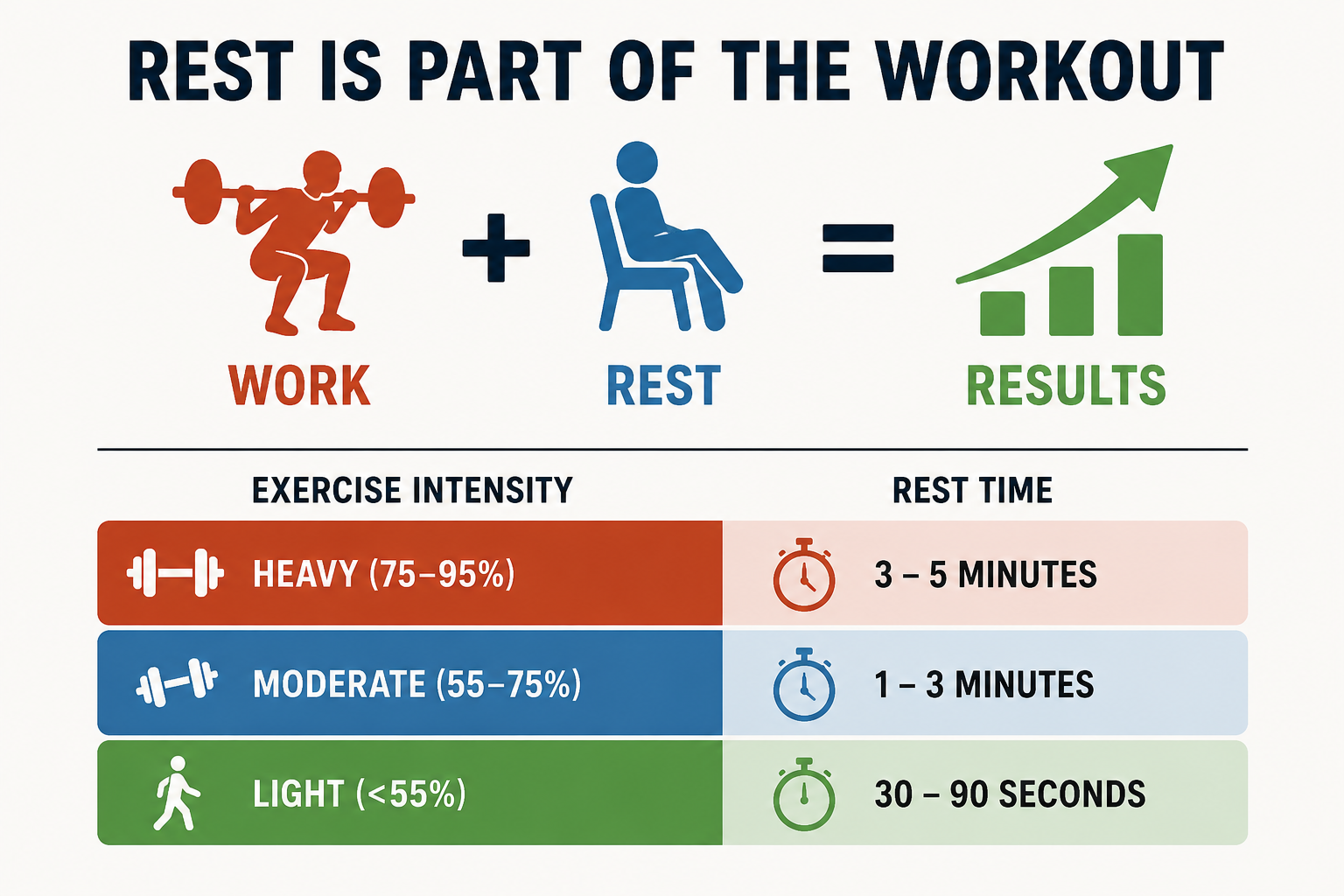
A workout consists of two equally important parts:

  1. The work.

  2. The recovery between bouts of work.

The quality of your results depends on both. In fact, one of the biggest mistakes people make is rushing from set to set because they think more effort equals more results. It doesn't.

When you cut your rest periods too short, you don't just make the workout harder—you make the next set worse.

Imagine you perform a heavy set of squats. The muscles, nervous system, and energy stores that power strength are temporarily depleted. They need time to recharge.

If you begin the next set before recovery is complete, you won't perform at your best. Instead of lifting at 100% of your potential, you may only be capable of producing 70-80%.

In other words, you voluntarily left 20-30% of that set on the table.

That's not toughness. That's poor programming.

Many experienced exercisers make this mistake because they judge recovery by how they feel.The problem is that feeling recovered and being recovered are not always the same thing. You may feel ready after ninety seconds. The truth often reveals itself halfway through the next set when the weight suddenly feels heavier, the bar moves slower, and performance drops.

The opposite mistake can happen too.

After several weeks or months of training, some people begin taking far more rest than they need, especially during lighter workouts. In these situations, excessive rest can make a workout drag on without providing additional benefit.

The key is matching your rest periods to the intensity of the work.

Remember

The goal is not to be tired.The goal is to improve. Sometimes that means working hard. Sometimes that means resting long enough to work hard again. Rest isn't the absence of training.

Rest is part of the training.

Comment

Ch 29 - HOW Should I Rest?

Comment

Ch 29 - HOW Should I Rest?

The short answer is simple:

Actively.

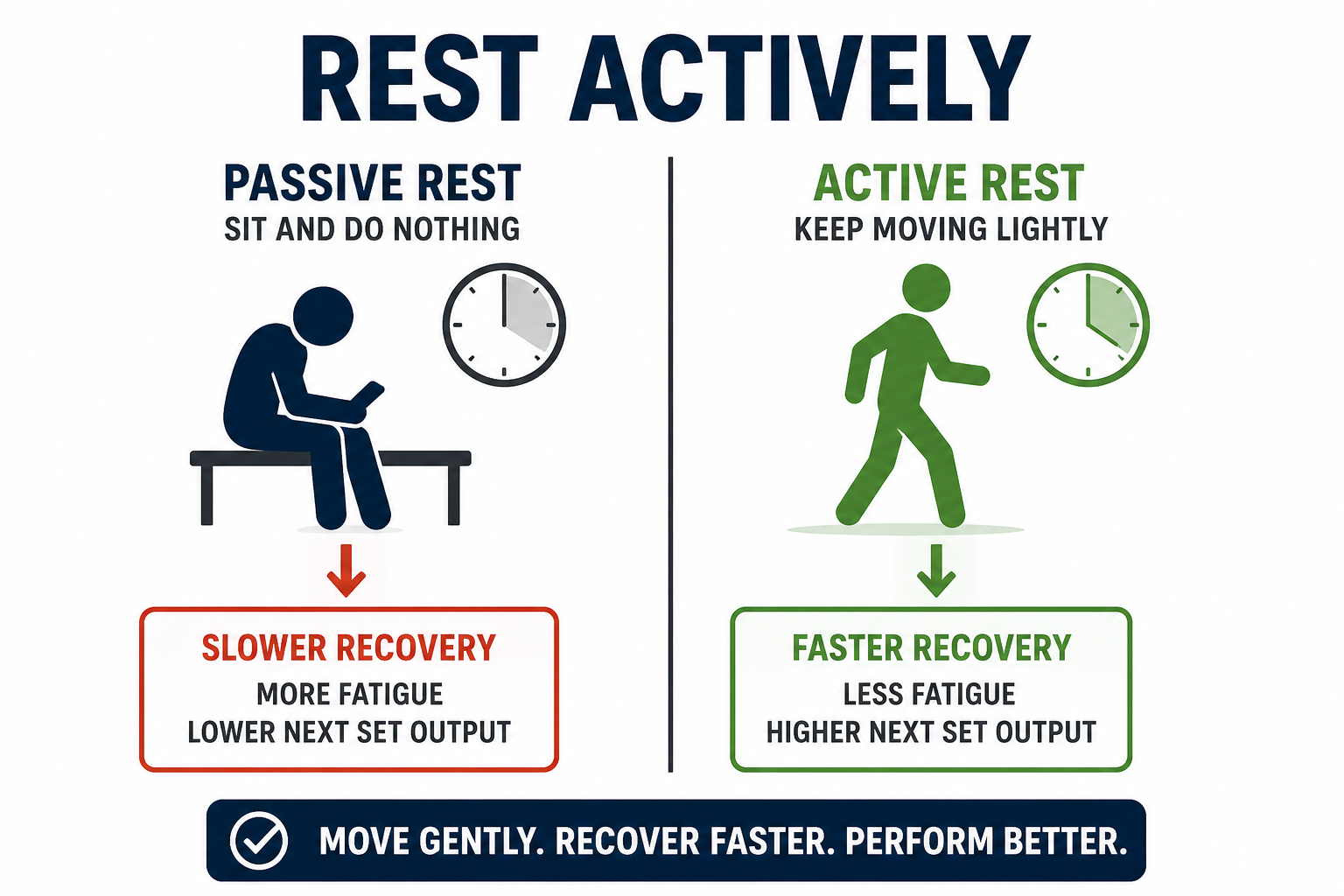
Most people think rest means sitting down, staring at their phone, and waiting for the next set. In many situations, there is a better option.

Light movement between sets can help you recover more quickly and improve the quality of your workout. Activities such as walking, easy cycling, light jogging, or jumping rope at a relaxed pace can keep blood flowing and help clear metabolic byproducts produced during exercise.

A good example comes from interval training. Many cyclists use intervals to improve their ability to produce high levels of power. During these workouts, they alternate periods of intense effort with periods of recovery. Researchers discovered that cyclists who continued pedaling lightly during their recovery periods recovered more quickly than those who stopped completely. The light movement helped clear lactate and other fatigue-producing byproducts from the working muscles.

The result was simple: they felt better, recovered faster, and were able to produce more power during the next work interval.

The same principle can apply to your workouts.

If you are performing strength training, conditioning work, or interval training, consider staying gently active during your recovery periods. Walk around the gym. Pedal a stationary bike. March in place. Perform some light mobility work. The goal is not to create additional fatigue, but simply to keep the body moving.

Active recovery won't always be appropriate. During very heavy strength training, you may need to conserve your energy and focus on full recovery between sets. However, during most light to moderate workouts, gentle movement can improve how you feel, enhance workout quality, and speed recovery.

Remember, the goal of rest is not inactivity. The goal of rest is recovery. Sometimes the best way to recover is to keep moving.

Comment

Ch 30 - Abuse It and Lose It

Comment

Ch 30 - Abuse It and Lose It

Most people have heard the phrase, "Use it or lose it."

When it comes to the human body, that's largely true. If you stop using a movement, you'll gradually lose the ability to perform it. If you stop walking, walking becomes difficult. If you stop reaching overhead, reaching overhead becomes difficult. The body adapts to whatever you ask of it—and whatever you neglect.

A fascinating example of this comes from India.

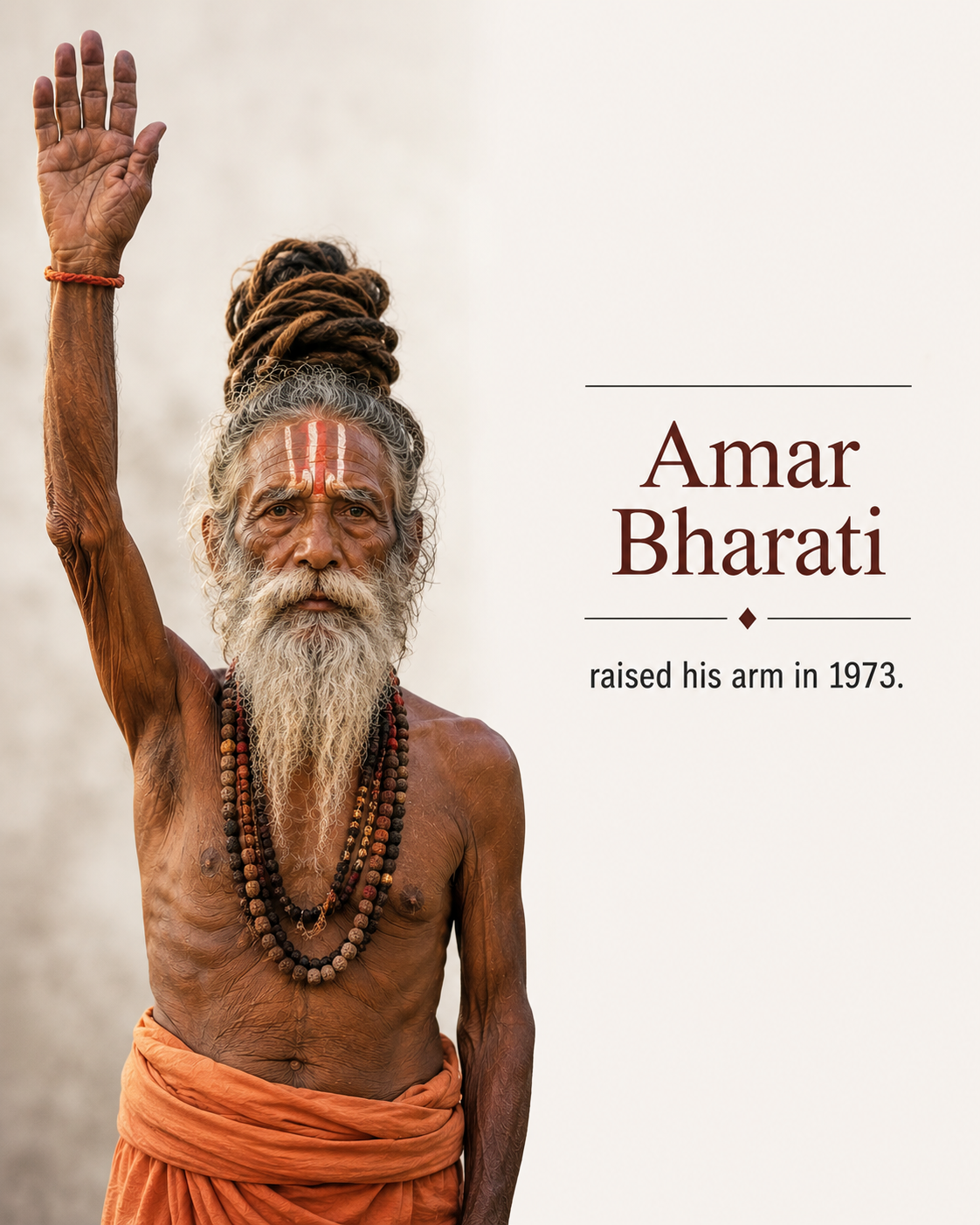
Depiction

A man named Amar Bharati became a Sadhu nearly fifty years ago. He left behind his family, career, and worldly possessions to dedicate himself to a spiritual life. At some point, he decided to demonstrate his devotion to Shiva by raising one arm above his head and keeping it there.

For the rest of his life. That was in 1973. Today, his arm remains permanently fixed in that position.

It's a remarkable demonstration of faith and dedication. It's also a remarkable demonstration of the body's ability to adapt. When a movement is abandoned long enough, the body eventually loses the ability to perform it.

This is one reason movement is so important. If you want to maintain the ability to push, pull, squat, hinge, carry, reach, climb, and play as you age, you must continue doing those things. Movement preserves movement.

But there is another lesson that becomes increasingly important as we get older.

"Use it or lose it" must never become "Abuse it and lose it."

Many fitness professionals preach full range of motion as if it were a sacred commandment. In an ideal world, perhaps it is. If a healthy twenty-year-old can comfortably move a joint through its entire range of motion, that's generally a good thing. The problem is that most of us aren't twenty years old anymore. Joints accumulate miles. Cartilage wears down. Arthritis develops. Old injuries leave their fingerprints behind. The body changes.

At some point, the question is no longer, "Can I perform the perfect exercise?" The question becomes, "How can I continue training safely for the next twenty years?" I learned this lesson the hard way.

When I was fifty years old, I was performing deep hack squats on a Smith machine. I had convinced myself that deeper was better and that full range of motion was always the correct answer. As I descended into one particularly deep squat, I felt and heard a sickening thud near my left hip and groin.

The pain was immediate and intense.

Being stubborn, I finished the repetition and reracked the weight. As I locked the bar in place, I felt another thud as my hip shifted back into position.

I had no idea there was anything wrong with my hip before that day. It took months to recover, and even now I can feel it when a storm rolls through town. If I get too ambitious with deep squats, it still reminds me of my mistake.

What I eventually learned is that there are certain joint positions that simply don't agree with my body anymore. Not because I have poor technique. Not because I'm weak. Not because I need a better warm-up. Because I'm over fifty-five years old.

For example, there are positions where my elbows hurt with almost no weight at all. Yet move them just a few degrees away from those positions and I can train hard, pain-free, and effectively. The same thing happens with my hips, knees, and shoulders.

Many people over forty-five discover the same thing. The answer isn't to stop exercising. The answer is to modify the exercise.

Today I often use slightly shorter ranges of motion than I did when I was younger. My squats stop a little higher. My deadlifts start from a slightly elevated position. Some pressing and pulling exercises are shortened just enough to keep my joints happy while still allowing me to train hard.

The goal is not to avoid movement. The goal is to preserve movement.

Whenever possible, use as much range of motion as you can comfortably tolerate. Learn the ideal movement pattern and strive toward it. But don't become so obsessed with perfection that you sacrifice longevity.

Pain is information.

If a movement consistently hurts, pay attention. Sometimes your body is telling you that a small modification would allow you to continue training productively for years to come.

Exercise should improve your life, not become a source of unnecessary wear and tear. As we age, movement remains essential. We still need strength. We still need muscle. We still need healthy bones, healthy joints, and healthy hearts. But wisdom becomes just as important as effort.

Move your body often. Move it in many different ways. Challenge it. Strengthen it. Preserve it. Just don't abuse it.

Because eventually, "Use it or lose it" can become "Abuse it and lose it."

And that's a lesson most of us only need to learn once.
Comment

Ch 31 - Excess Volume is the Enemy

Comment

Ch 31 - Excess Volume is the Enemy

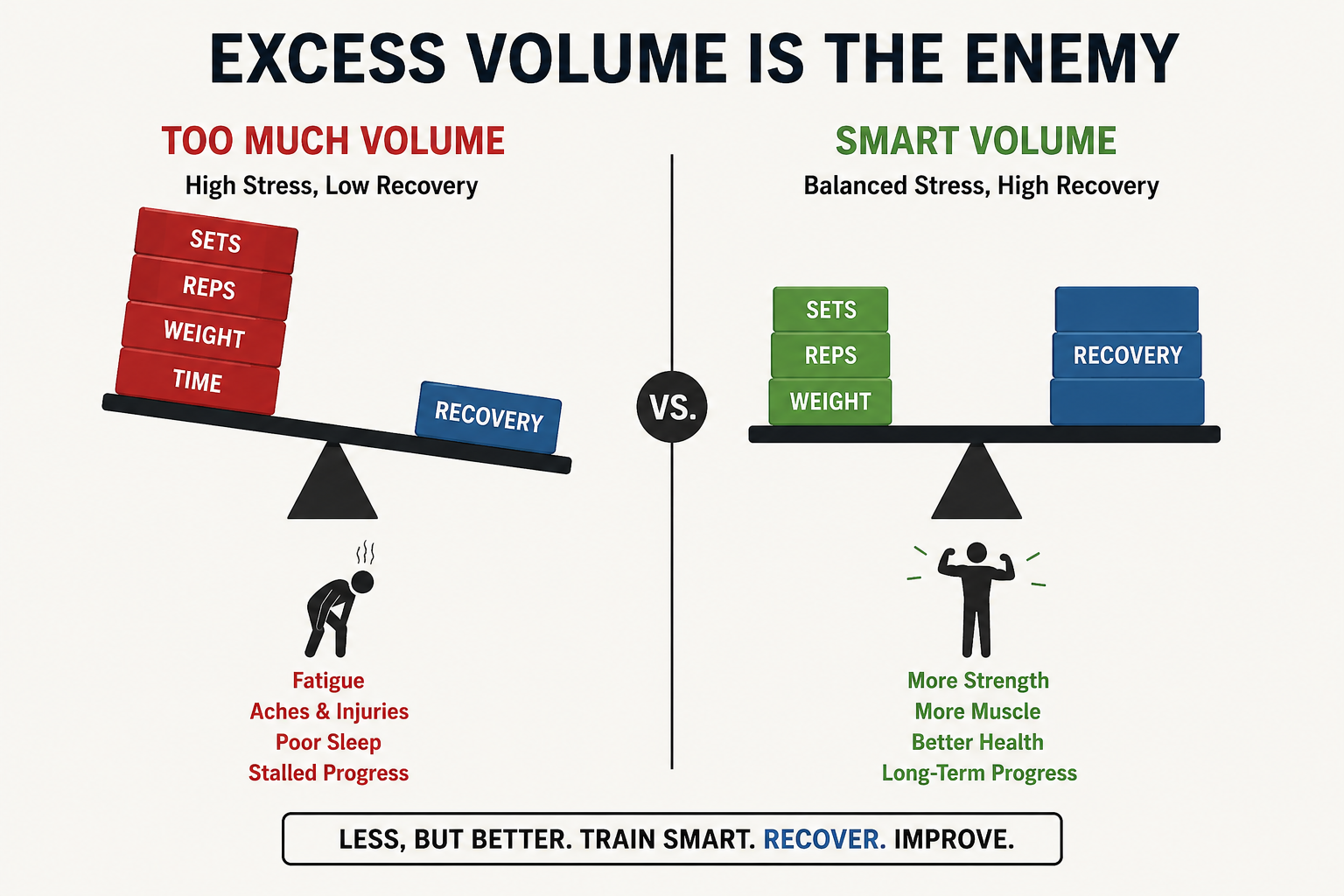
Volume refers to the total amount of physical work performed during a set, workout, or training program. In strength training, volume is often measured as sets × reps × weight. The greater the volume, the greater the stress placed upon the body. Stress is necessary for growth, but like medicine, the dose matters. Too little produces no effect. Too much produces harm. For those of us over 45, this distinction becomes increasingly important because while our ability to adapt remains impressive, our ability to recover is no longer unlimited.

There is an old belief in fitness that if some exercise is good, more exercise must be better. This idea has fueled countless high-volume training programs promising faster results through harder work. Unfortunately, after 40, the body often stops rewarding excess and starts demanding wisdom. The truth is simple: excess volume is the enemy.

When we were younger, our bodies tolerated almost any abuse we could imagine. We could sleep poorly, train six days per week, chase soreness, and pile on set after set with little consequence. Even poorly designed programs often produced results because youth itself is an extraordinary recovery tool. In our 40s, 50s, and beyond, that recovery reserve gradually shrinks. The body becomes less willing to forgive foolishness. Excessive training no longer creates fitness—it often creates fatigue, pain, and stagnation.

But this is not all bad news.

As the old Toby Keith song reminds us, "I ain't as good as I once was, but I'm as good once as I ever was." There is profound wisdom in those words. While we may not recover from endless training sessions like we once did, many older adults discover something surprising: they can often achieve remarkable results with much less work.

Over the years, my peers and I have repeatedly observed this phenomenon. Older lifters frequently gain strength and muscle using lower volumes than younger trainees. I personally have gained more muscle and strength in my fifties than at many earlier points in my life, including setting a lifetime bench press personal record at age 51. This seems counterintuitive, but it happens often enough that it cannot simply be dismissed as anecdote.

Why does this occur? Perhaps decades of movement create superior motor control. Perhaps muscle memory allows older adults to recruit muscle fibers more efficiently. Perhaps experience improves exercise execution and effort. Scientists continue to investigate these questions. Frankly, I care less about the exact mechanism than the outcome. The outcome is clear: many adults over 45 can achieve exceptional results with surprisingly little training volume.

This realization changes everything.

After 45, recovery becomes the currency of progress. Every unnecessary set is a withdrawal from your recovery account. Spend enough withdrawals without making deposits and eventually the bill comes due. It arrives disguised as sore joints, chronic fatigue, poor sleep, nagging injuries, or stalled progress. The goal is no longer to survive a workout. The goal is to recover from it and improve because of it.

When I program for adults over 45, the first thing I usually do is reduce volume. Then I increase quality. Fewer exercises. Fewer sets. Better technique. Heavier loads when appropriate. Longer rest periods. This approach consistently produces better results with less wear and tear.

I use the following guidelines when programming for strength 45+: 


Strength Training Guidelines 45+ 

  • 5 -10 sets per muscle group per week (lean more toward 5).

  • High volume is the enemy (V= sets x reps x weight)

  • Higher intensity is better 

  • Intensity is measured in weight 

  • Use 60-80 percent of 1RM for intensity

  • 5-8 reps per set. Stay on the lower side of this

  • Leave 2-3 Reps in Reserve (RIR)

  • Advanced routines using more than 8 sets and/or 8 reps should be limited to 6 wk training phases

  • This advanced phase may only be performed 1x/quarter

  • Exercise each muscle group 1x/wk unless doing an advanced routine 

  • Advanced routines using more than 6 sets/week should be limited to 6 wk training phases

  • This advanced phase may only be performed 1x/3 mo

  • Rest 2-5 minutes between each set or until completely recharged

  • Rest each muscle group, at least 48 hours after a workout


GPP Conditioning is a different thing


GPP Conditioning: 

  • Perform between 100-150 reps per movement patter (push, pull, squat, core) per week

  • Use light-ish weights 

  • Use RPE to measure intensity.

  • Never work above a 7 RPE

  • Exercise muscle groups 1-3x/wk

  • Rest as needed

  • Never red-line a workout. 


I know what many people are thinking: "This can't possibly be enough." After decades of believing that more is always better, reducing training volume can feel uncomfortable. It can even feel like laziness. But eventually age teaches us all the same lesson. The body no longer rewards punishment. It rewards wisdom.

At some point, every athlete learns an important truth: after 45, recovery is no longer the thing that happens after training.

Recovery is the training.

Comment

Ch 32 - The Subtle Art of Not Maxing Out

Comment

Ch 32 - The Subtle Art of Not Maxing Out

One of the biggest mistakes people make in the gym is believing that every workout should leave them exhausted. Somewhere along the way, we started confusing effort with effectiveness. We began treating soreness like a badge of honor and fatigue like proof of hard work. The fitness world often celebrates those who train until they collapse, but after 45, that mindset starts sending us an invoice.

Comment