We've all got a few miles on us.
Most of our miles were hard miles.
I love that.
Our scars, limps, gimps, replaced joints, aching backs, and sore shoulders aren't just injuries. They're stories. Stories about raising kids, climbing mountains, working construction, military service, football games, ski accidents, hard work, and lives fully lived. I'm proud of mine. You should be proud of yours.
The upside—and the downside—is that we actually lived those stories. We earned every ache we've got. Unfortunately, those aches and pains are also the number one reason many people our age stop exercising.
That breaks my heart because it's exactly backwards.
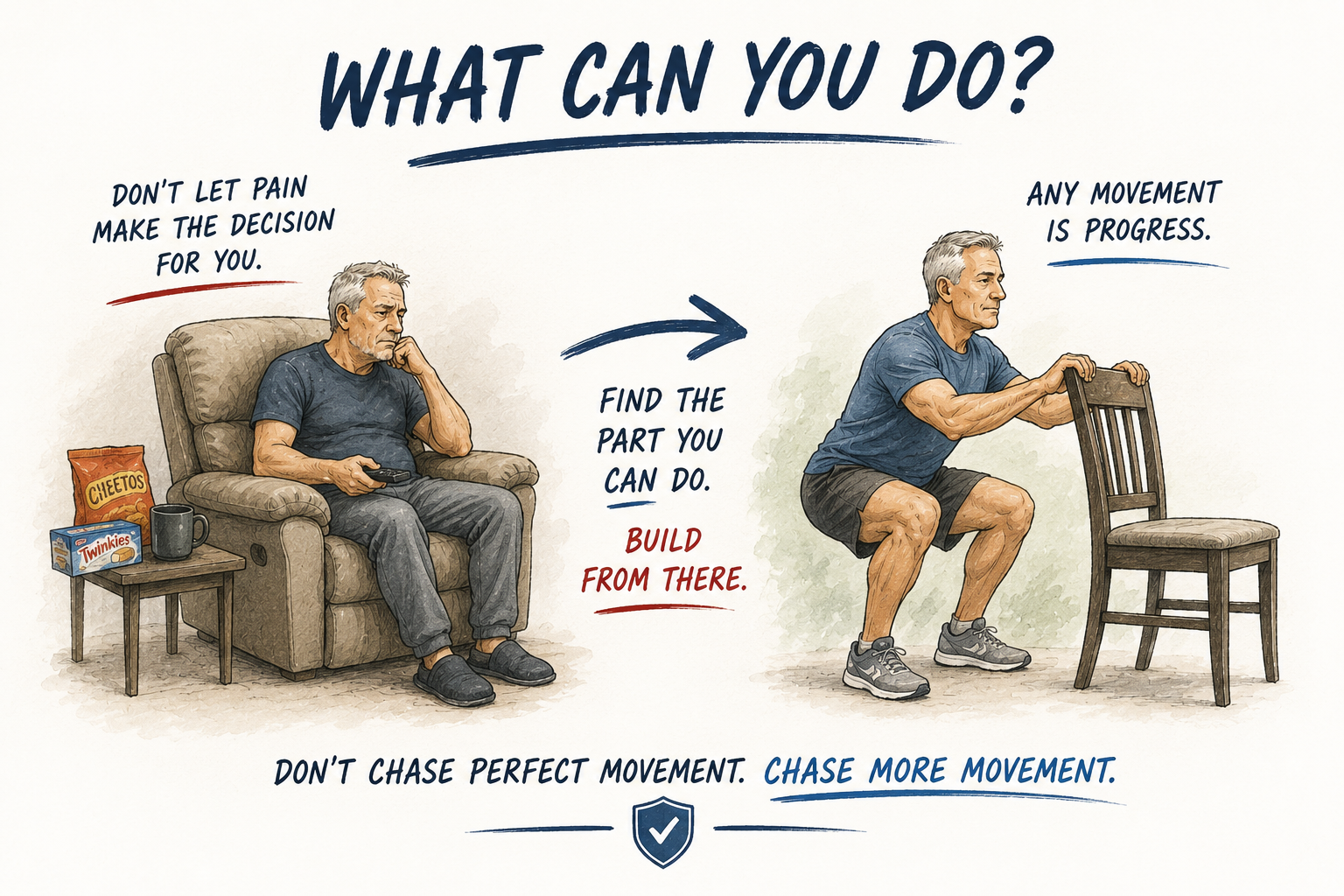
I have an old buddy I haven't seen in more than thirty-five years. His sister-in-law recently told me he's basically done. He spends his days sitting in a recliner, eating Twinkies and Cheetos, watching television because he's in too much pain to move around anymore.
That one hurt to hear.
This guy was one of the toughest men I ever knew. Somewhere along the way he became convinced that pain meant he should stop moving. Sadly, that's the path so many people take.
Here's the irony. For many of us, intelligent movement is one of the best pain relievers available. The worst thing many of us did to our bodies happened back in the eighties and nineties. The second worst thing we can do now is stop moving altogether.
Whenever someone tells me, "Neil, I can't do that exercise. It hurts too much," my response is always the same.
"What can you do?"
Let's say I ask you to squat. You tell me your knees hurt. Fine. How far can you squat before they hurt? That's today's squat. Maybe it's only six inches. Perfect. We'll build from there.
Sometimes people tell me, "Everything hurts. I can't do any of it."
Really?
Can you sit down in a chair? That's half a squat. Can you stand back up? That's the other half. Can you get into your car? Can you get out? Can you climb one stair? Can you step over the curb in a parking lot?
Congratulations.
You're already squatting.
Not perfectly. Not deeply. But enough to begin.
That's all I need.
One of the biggest mistakes older adults make is believing an exercise only counts if they can perform the entire movement exactly the way they see it online or in a gym. Those standards weren't created to improve your health. Most were created for sports performance or strength competitions where everyone needed to follow the same rules.
Your body doesn't care about the rules of a powerlifting meet.
Your body cares that you moved.
Half of a squat isn't nothing. A partial overhead press isn't nothing. A shortened pull-down isn't nothing. Every piece of movement counts. Strong athletes have used partial repetitions for decades as part of intelligent training. We can use them too, especially when our joints have seen better days.
As you train, let pain be your guide. Don't force movements that hurt or leave you flared up for days afterward. Pain is information. Listen to it. At the same time, don't confuse discomfort with damage. Your muscles may get tired. Your lungs may burn a little. That's normal. Sharp pain inside a joint or pain that lingers for days is your body asking you to change something.
Pain can also be sneaky. Sometimes a workout feels great while you're doing it, but tomorrow morning your shoulder or knee reminds you that you did too much. That's valuable information. Learn from it. Adjust your next workout accordingly. Remember, if today's workout keeps you from tomorrow's workout, it probably wasn't a very good workout.
Over time, something remarkable often happens. Today's half squat becomes tomorrow's three-quarter squat. Eventually it becomes a full squat. Sometimes it doesn't, and that's okay too. Progress isn't measured by perfection. It's measured by capability.
Whenever you come across an exercise you can't perform exactly as written, don't ask yourself, "Why can't I do this?"
Ask yourself, "What can I do?"
Then go do that.
Because every healthy movement you make is a vote for the person you're still becoming.