Recovery Is Training
One of the biggest mistakes people over forty-five make is believing that more work always produces more results.
It doesn't.
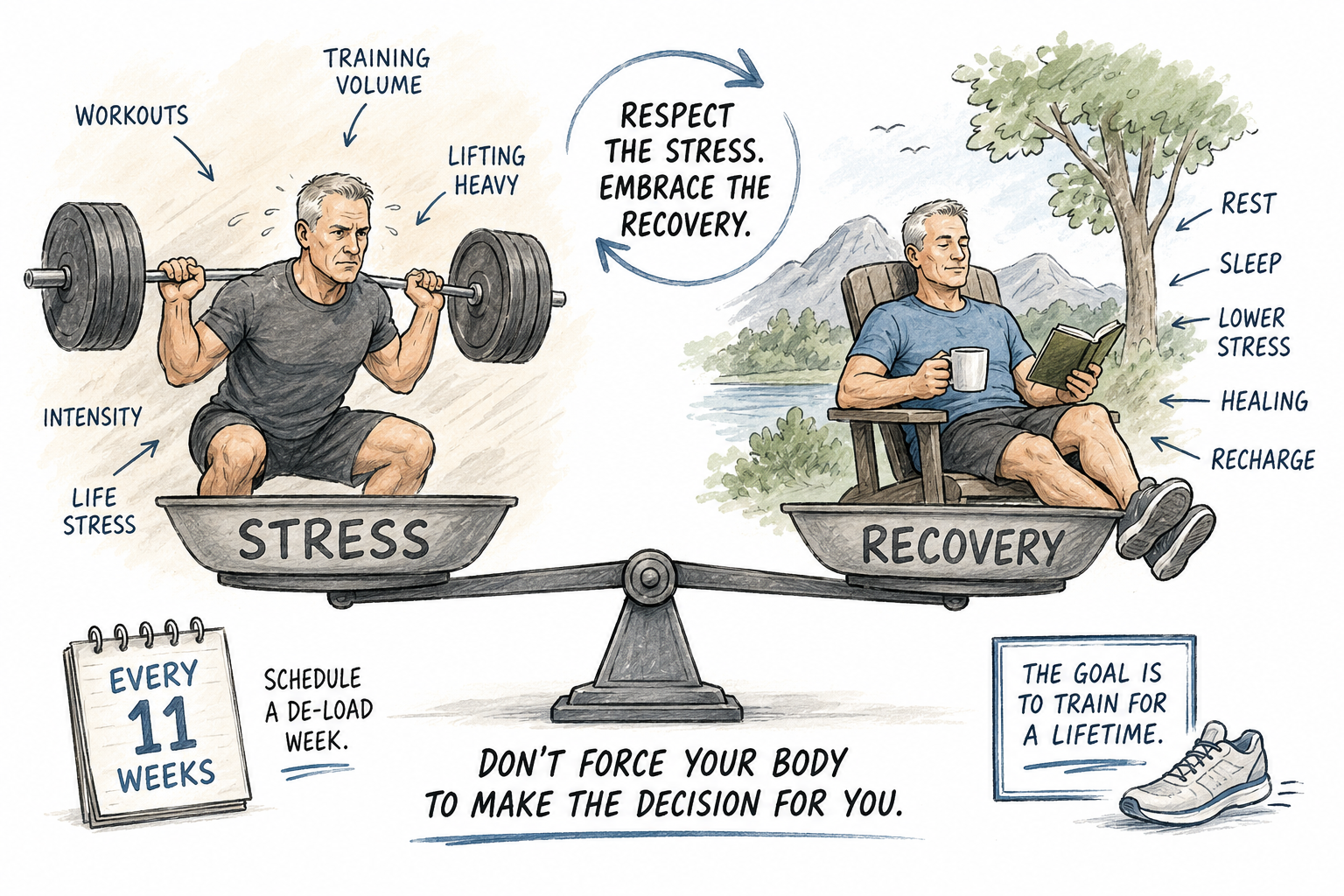
Every workout creates stress. Your muscles, tendons, joints, nervous system, hormones, and immune system all pay part of that bill. The workout itself doesn't make you healthier. Recovery does.
You don't become stronger while lifting the weight. You become stronger after you put it down.
That distinction becomes increasingly important with age.
When we're young, our bodies tolerate an astonishing amount of abuse. We recover quickly. We bounce back. We get away with things we probably shouldn't. As we grow older, however, recovery becomes a skill instead of an accident.
The people who remain healthy into their sixties, seventies, and beyond are rarely the ones who trained the hardest. They're the ones who trained the longest. Longevity almost always beats intensity.
Every eleven weeks I recommend performing a full week of de-loading. Not because you're weak, but because you're smart. You are respecting the biology of an aging body instead of fighting against it.
One of the biggest traps I see is people proudly announcing how hard they still train. They brag about marathon workouts, enormous training volumes, and lifting huge weights despite their age. They wear exhaustion like a badge of honor.
I understand the temptation. Part of us wants to prove we still "have it."
But our goal isn't to prove how tough we are.
Our goal is to stay healthy long enough to enjoy the strength we've built.
There is a tremendous difference.
Driving your body at full throttle every day is no wiser than driving your truck at 120 miles per hour everywhere you go. You may get away with it for a while, but eventually something breaks. Don't force your body to make the decision for you.
When it's time to de-load, you have two simple options:
Take the entire week off. Enjoy your life. Spend time with your family. Go hiking. Read a book. Sleep in. Fitness should improve your life, not consume it.
Cut everything in half. Half the weight. Half the reps. Half the sets. Half the rounds. Half the distance. Half the time. Everything should feel almost ridiculously easy. Use the extra time and energy to do something meaningful—or do nothing at all. You've earned it.
A proper de-load allows your body to finally catch up with the work you've already done. Most people think they're losing fitness during a recovery week. In reality, they're uncovering it. Fatigue has simply been hiding it.
The benefits of de-loading extend far beyond your muscles.
Improves performance during future workouts
Decreases resting heart rate
Improves reaction time
Improves strength and endurance
Increases energy
Improves digestion
Reduces cravings
Significantly improves mood
Lowers stress hormone production
Improves sleep
Strengthens immune function
Allows nagging injuries to heal
Supports healthy testosterone production
Reduces psychological stress
Helps reduce symptoms of depression
Understand that "every eleven weeks" is not a magic number. Some people may need a de-load every eight weeks. Others every six. Life itself creates stress. Poor sleep, work demands, travel, illness, family responsibilities, and emotional strain all count toward your total stress load. Your body doesn't care whether the stress came from deadlifts or your boss. It simply responds to the total amount placed upon it.
Learn to pay attention.
Rest frustrates almost everyone. It can feel like you're losing ground. You're not. You're protecting it.
A week spent recovering may prevent months spent recovering from a serious injury. The goal has never been to win this month. The goal is to still be lifting, hiking, traveling, playing with your grandchildren, and living independently decades from now.
Recovery isn't a sign of weakness.
Recovery is part of the training.
Sometimes the strongest thing you can do... is take the week off.