One of the biggest mistakes people make in the gym is believing that every workout should leave them exhausted. Somewhere along the way, we started confusing effort with effectiveness. We began treating soreness like a badge of honor and fatigue like proof of hard work. The fitness world often celebrates those who train until they collapse, but after 45, that mindset starts sending us an invoice.
Working out at maximum intensity on every set exposes us to unnecessary injury, joint pain, and overtraining. Those of us over 45 pay an even steeper price because recovery becomes slower and the consequences become larger. Injury robs us of health, momentum, and good intentions. I don't know about you, but at this stage of life, I have no desire to spend six months rehabbing an injury I earned trying to impress nobody.
We'll leave that kind of behavior to younger—dumber—folk.
Over the past decade, strength athletes around the world have quietly discovered something remarkable. Many of the strongest lifters on Earth no longer train by maxing out every workout. Instead, they use carefully planned training systems that allow them to handle less stress while producing better results. Their goal isn't to survive training. Their goal is to train for decades.
That sounds a lot like our goal.
Now, to be clear, you and I aren't trying to break world records. Nobody over 45 needs to squat 800 pounds to live a long, healthy life. What we need is something far more valuable: strong muscles, healthy bones, resilient joints, and the ability to do the things we love for as long as possible.
In many ways, preserving muscle is the closest thing we've discovered to a fountain of youth.
Muscle protects us from frailty. It improves insulin sensitivity, supports healthy metabolism, strengthens bones, and preserves independence. If aging is the gradual loss of capability, then strength training is one of our greatest defenses against it.
Fortunately, we can steal many of the methods used by elite lifters without adopting their risks.
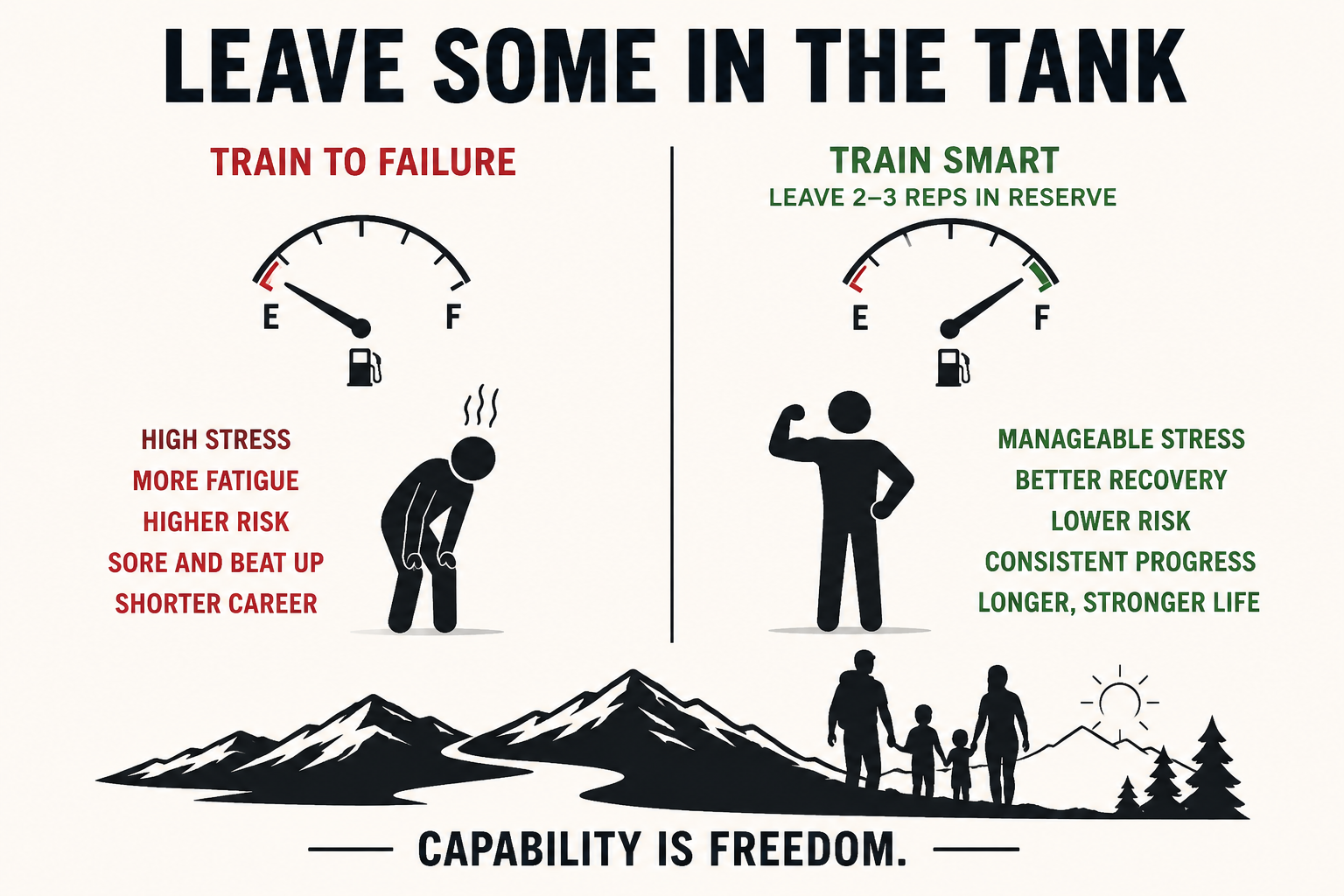
One of the most powerful techniques is called Reps in Reserve, or RIR. The idea is simple: never empty the tank.
Instead of lifting until failure, you stop each set while you still have two or three good repetitions left. If you perform a set of five reps and honestly believe you could have completed seven or eight, you've done it correctly. You worked hard enough to stimulate adaptation, but not so hard that you buried yourself in fatigue.
This changes everything.
For decades, many people believed that muscle and strength could only be built by pushing every set to the limit. But modern evidence and practical experience suggest otherwise. You can become remarkably strong while leaving a little in reserve. In fact, for most adults over 45, this approach often produces better results with fewer injuries and far less fatigue.
Think of it this way: your body doesn't reward you for how tired you become. It rewards you for the training stimulus you can repeatedly recover from.
Consistency beats heroics.
This is why I almost never max out anymore.
Honestly, I think maxing out is mostly stupid.
The risk is high. The reward is small. And the older I get, the more I value longevity over ego. Don't misunderstand me—I still love lifting heavy things. I just want to keep doing it twenty years from now.
A few years ago, my sons and I started bench pressing together on Saturday mornings. Those mornings have become some of my favorite memories as a father. We laugh, tease each other, talk about life, and move iron together. That's the real magic of strength training.
The problem was my shoulders.
I had torn one rotator cuff skipping rocks on the Great Salt Lake while showing off for my kids. I tore the other wrestling my son. That fourteen-year-old nearly tore me in half and almost broke my neck. I was lucky to walk away with only a shoulder injury.
Bench pressing became painful.
But I love the bench press. More importantly, I believe strength is too valuable to surrender.
So I started over.
And when I say started over, I mean embarrassingly over.
I still remember the day I finally bench pressed 65 pounds pain-free. I took a victory lap around the gym. People actually clapped. I wasn't embarrassed. I was grateful.
Slowly, patiently, I rebuilt.
Over the next two years, I worked my way up to a respectable 155-pound bench press. I was proud of it. I stayed there for a long time because I didn't want to risk another injury.
Then one Saturday my son watched me move 155 pounds with ease.
"Dad," he asked, "how much do you think you could do?"
Somewhere deep inside my head I heard Tim "The Tool Man" Taylor make that ridiculous man-grunt sound.
Before I knew it, 225 pounds was loaded on the bar and I was lying underneath it questioning every decision I'd ever made.
"Do it and you're cool!" my sons chanted.
To her credit, Lindsay was the only person in the room showing any common sense.
"Are you sure?" she kept asking.
Testosterone was running high that day, my friend.
I figured I'd just lift the bar off the rack and feel the weight. What could it hurt?
The next thing I knew, I was pressing rep after rep.
Five of them.
Here's why that's important: I had never performed five repetitions with 225 pounds in my entire life.
Three months later, I benched an all-time personal record of 315 pounds.
At 51 years old.
How was that possible?
Programming.
Careful programming. Submaximal training. Reps in reserve. Intelligent progression. Patience.
Not punishment.
Programming designed specifically to build strength while preserving the body.
When I locked out that final rep, I nearly cried.
You might too someday.
The day you realize that you can become stronger, leaner, healthier, and more capable while doing less total work than you once believed possible—that is a very good day indeed.
Strength training offers gifts that extend far beyond the gym. Stronger muscles support a higher metabolism. Strength improves insulin sensitivity, helping the body manage blood sugar more effectively. It builds denser bones, protects joints, reduces injury risk, and helps preserve the independence that all of us hope to maintain as we age. Many people also find that strength training improves energy, decreases pain, and dramatically enhances quality of life.
Perhaps most importantly, strength allows us to continue showing up for the people and experiences that matter most. It allows us to hike mountains, play with grandchildren, carry groceries, travel the world, and live life on our own terms.
This is why we train.
Not for trophies.
Not for six-pack abs.
Not to impress strangers on the internet.
We train because capability is freedom.
Strength does not belong to the young. It belongs to those wise enough to keep showing up.