The short answer is simple:
Actively.
Most people think rest means sitting down, staring at their phone, and waiting for the next set. In many situations, there is a better option.
Light movement between sets can help you recover more quickly and improve the quality of your workout. Activities such as walking, easy cycling, light jogging, or jumping rope at a relaxed pace can keep blood flowing and help clear metabolic byproducts produced during exercise.
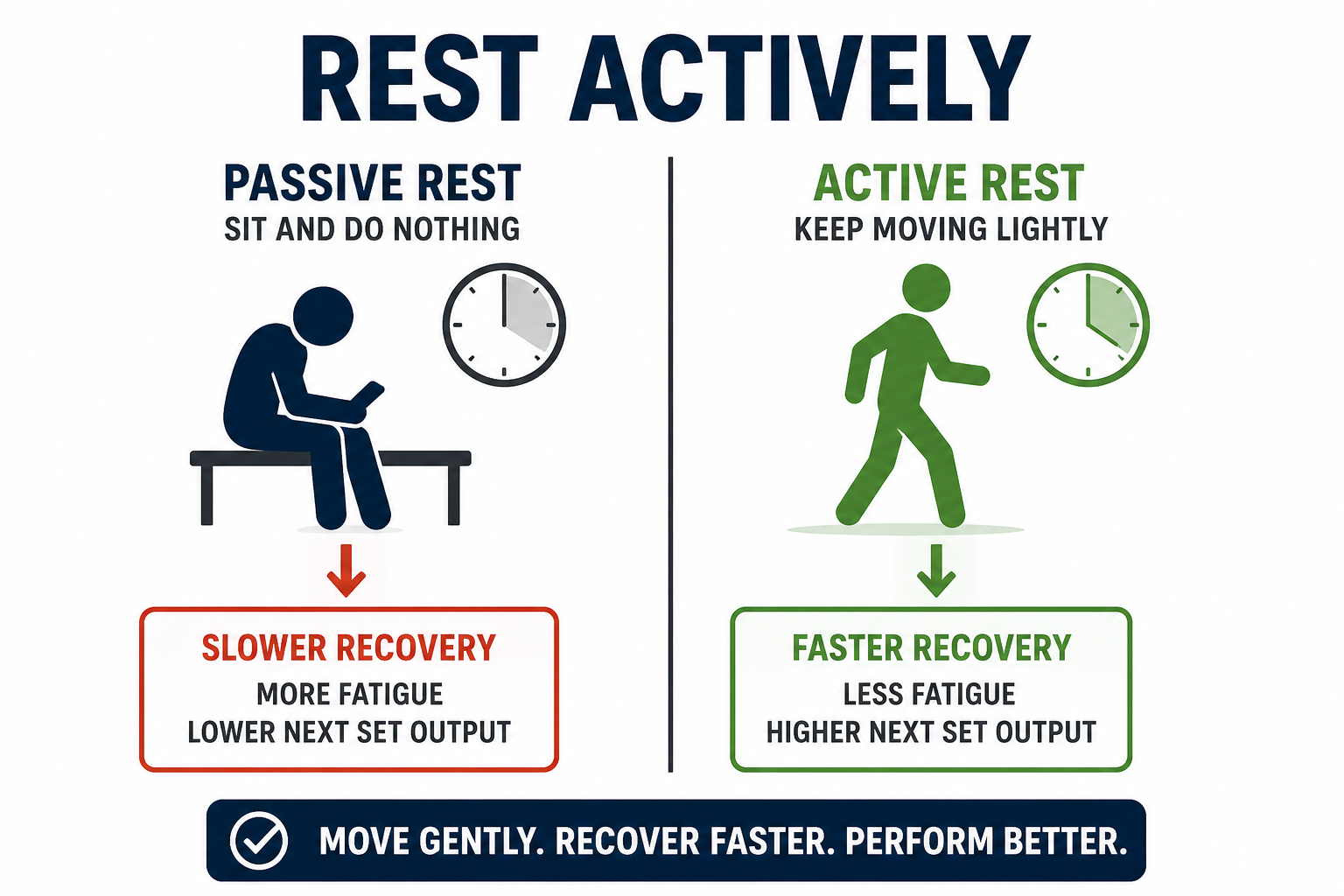
A good example comes from interval training. Many cyclists use intervals to improve their ability to produce high levels of power. During these workouts, they alternate periods of intense effort with periods of recovery. Researchers discovered that cyclists who continued pedaling lightly during their recovery periods recovered more quickly than those who stopped completely. The light movement helped clear lactate and other fatigue-producing byproducts from the working muscles.
The result was simple: they felt better, recovered faster, and were able to produce more power during the next work interval.
The same principle can apply to your workouts.
If you are performing strength training, conditioning work, or interval training, consider staying gently active during your recovery periods. Walk around the gym. Pedal a stationary bike. March in place. Perform some light mobility work. The goal is not to create additional fatigue, but simply to keep the body moving.
Active recovery won't always be appropriate. During very heavy strength training, you may need to conserve your energy and focus on full recovery between sets. However, during most light to moderate workouts, gentle movement can improve how you feel, enhance workout quality, and speed recovery.
Remember, the goal of rest is not inactivity. The goal of rest is recovery. Sometimes the best way to recover is to keep moving.