
Walking may be the most underrated health intervention ever discovered.
That is a strange thing to say about an activity so ordinary. Walking isn't intense. It isn't impressive. Nobody posts videos of themselves proudly walking around the block. There are no walking competitions on television. No one buys special supplements to improve their walking performance.
Yet walking consistently produces health outcomes that seem wildly disproportionate to the effort involved. It almost doesn't make sense.
As a young physical therapy aide, I witnessed this firsthand.
One of my patients was a woman I had known since childhood. She had been the lunch lady at my elementary school. She was one of those people everybody loved. Unfortunately, she was dying from advanced cancer and had been admitted to the hospital for comfort care.
Part of my job was to get patients out of bed and walk with them through the halls. Twice each day, I would help her stand and we would slowly make our way down the corridor.
At first, she could barely walk. A few days later she was walking farther. Then farther still.
Soon she was requesting longer walks. Her energy improved. Her mood improved. Her appetite improved. She became stronger.
The cancer was still there. The outcome was unchanged. But the walking seemed to awaken something inside her.
Eventually the physicians asked us to stop encouraging the walks. Their goal was to allow her to pass peacefully rather than continue fighting a battle she could not win.
A few days later she died. I have never forgotten her. Not because walking cured her. It didn't. I remember her because walking helped her live. Even in the final chapter of her life, something as simple as putting one foot in front of the other improved the quality of her days.
That experience left me with a question that has followed me for more than thirty years.
Why is walking so powerful?
Walking shouldn't be this effective. From an exercise perspective, it is almost too easy.
Humans are extraordinarily efficient walkers. In fact, walking is one of the most energy-efficient forms of locomotion in the animal kingdom. Our bodies evolved specifically for it. We don't huff and puff. We don't generate enormous amounts of fatigue. We don't require long recovery periods.
Walking doesn't feel like exercise in the way running, cycling, rowing, or swimming do. Yet the health benefits are undeniable. And OH … The benefits!
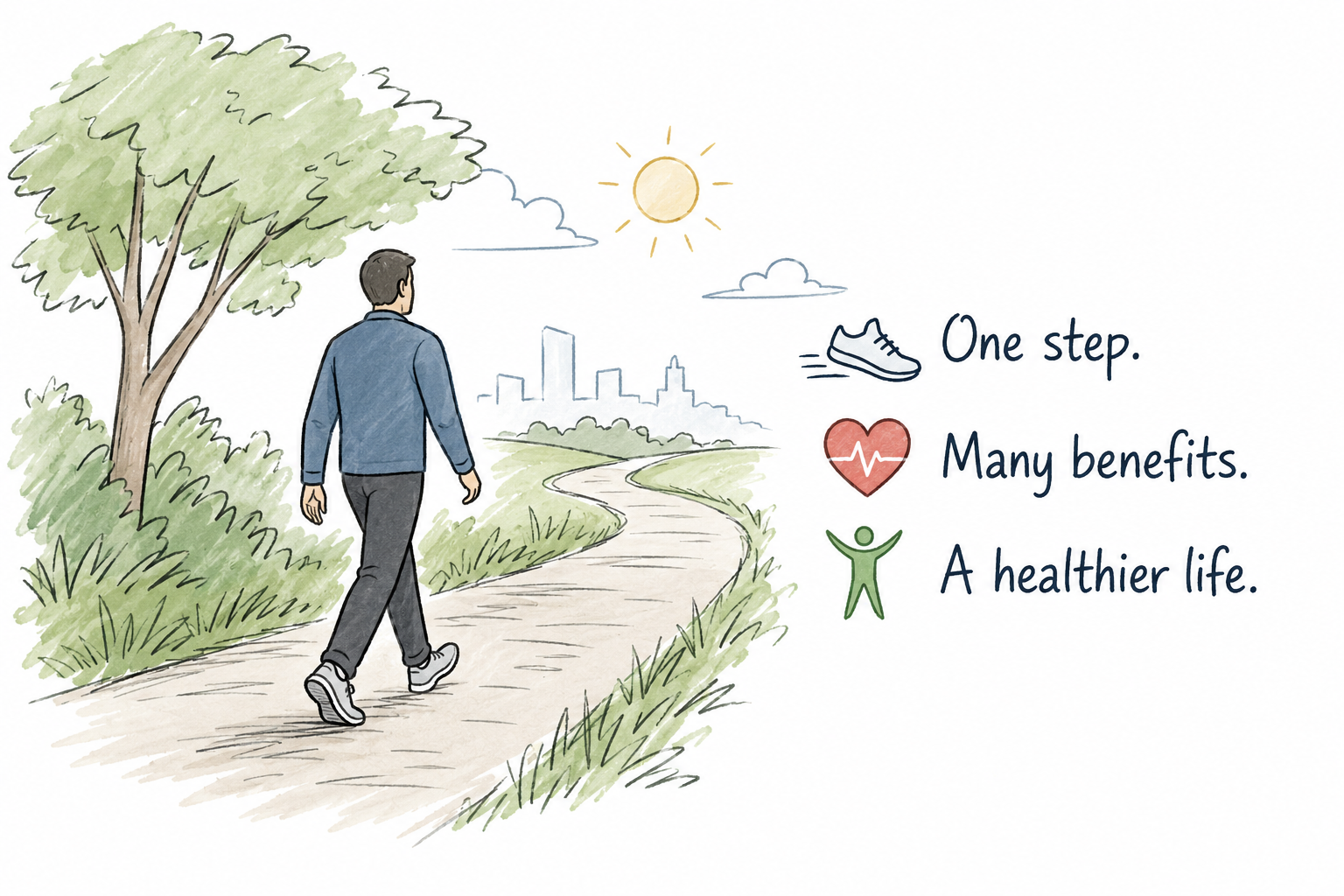
Walking improves blood sugar control.
Walking improves insulin sensitivity.
Walking lowers blood pressure.
Walking improves cardiovascular health.
Walking reduces inflammation.
Walking improves mood.
Walking improves sleep.
Walking helps regulate appetite.
Walking helps maintain healthy body weight.
Walking strengthens bones.
Walking preserves mobility.
Walking improves balance.
Walking reduces the risk of premature death.
That's a remarkable list for something that most people don't even consider exercise.
Maybe, It’s NOT Simply Exercise
Part of the mystery may be that walking is not simply exercise.
Walking is movement. And movement appears to be something the human body desperately expects from us. For millennia, humans walked. We walked to hunt. We walked to gather. We walked to explore. We walked to socialize. We walked to survive.
Movement wasn't a workout. It was life itself.
Today we spend much of our day sitting in chairs, staring at screens, riding in cars, and living in environments that require almost no physical movement. Then we attempt to compensate by exercising intensely for thirty or sixty minutes a few times per week. While exercise is valuable, it may not fully replace the biological signals generated by simply being on our feet throughout the day.
There appears to be something special about the rhythmic nature of walking. The alternating movement of the limbs. The loading and unloading of the joints. The gentle impacts through the feet. The constant balance adjustments. The repeated muscle contractions. The visual flow of the environment moving around us. The steady demand placed upon the cardiovascular system. All of these systems communicate with one another continuously.
Walking is less like exercising a muscle and more like firing up the entire organism.
Just Walk
Modern fitness culture often tries to make walking more complicated than it needs to be. People become obsessed with heart rate zones. They track pace. They track distance. They track calories. They track elevation gain. They track everything.
There is nothing wrong with those things. But sometimes we become so focused on optimizing walking that we forget to simply walk. If you enjoy tracking your heart rate, great. If you enjoy Zone 2 training, great. But if you are over forty-five and asking me where to begin, my answer is simple:
Get on your feet. Walk.
Not because it is perfect. Not because it is optimal. Not because your watch approves.
Walk because human beings were designed to walk.
Walk because your body recognizes it. Walk because your joints tolerate it. Walk because your heart benefits from it. Walk because your brain needs it. Walk because your metabolism responds to it. Walk because your spirit seems to respond to it too.
How Much?
If I could prescribe a single health habit for most adults, it would be this:
Accumulate 6,000 to 10,000 steps per day.
Not all at once. Not as a punishment. Not as a workout. Simply as a way of life.
Park farther away.
Walk the dog.
Walk with your spouse.
Walk after meals.
Walk while talking on the phone.
Walk while thinking.
Walk while praying.
Walk while solving problems.
Walk because you can.
One day there will come a time when you cannot. The goal is not to become a better walker. The goal is to become a healthier human being. Walking is not glamorous. It is not complicated. It may not even feel like exercise. And that may be exactly why it works so well.
Somewhere within those thousands of simple daily steps lies one of the greatest health mysteries ever discovered. Fortunately, you do not have to understand the mystery to benefit from it.
You simply have to take the next step.