Viewing entries in
Book

Ch 30 - Abuse It and Lose It

Comment

Ch 30 - Abuse It and Lose It

Most people have heard the phrase, "Use it or lose it."

When it comes to the human body, that's largely true. If you stop using a movement, you'll gradually lose the ability to perform it. If you stop walking, walking becomes difficult. If you stop reaching overhead, reaching overhead becomes difficult. The body adapts to whatever you ask of it—and whatever you neglect.

A fascinating example of this comes from India.
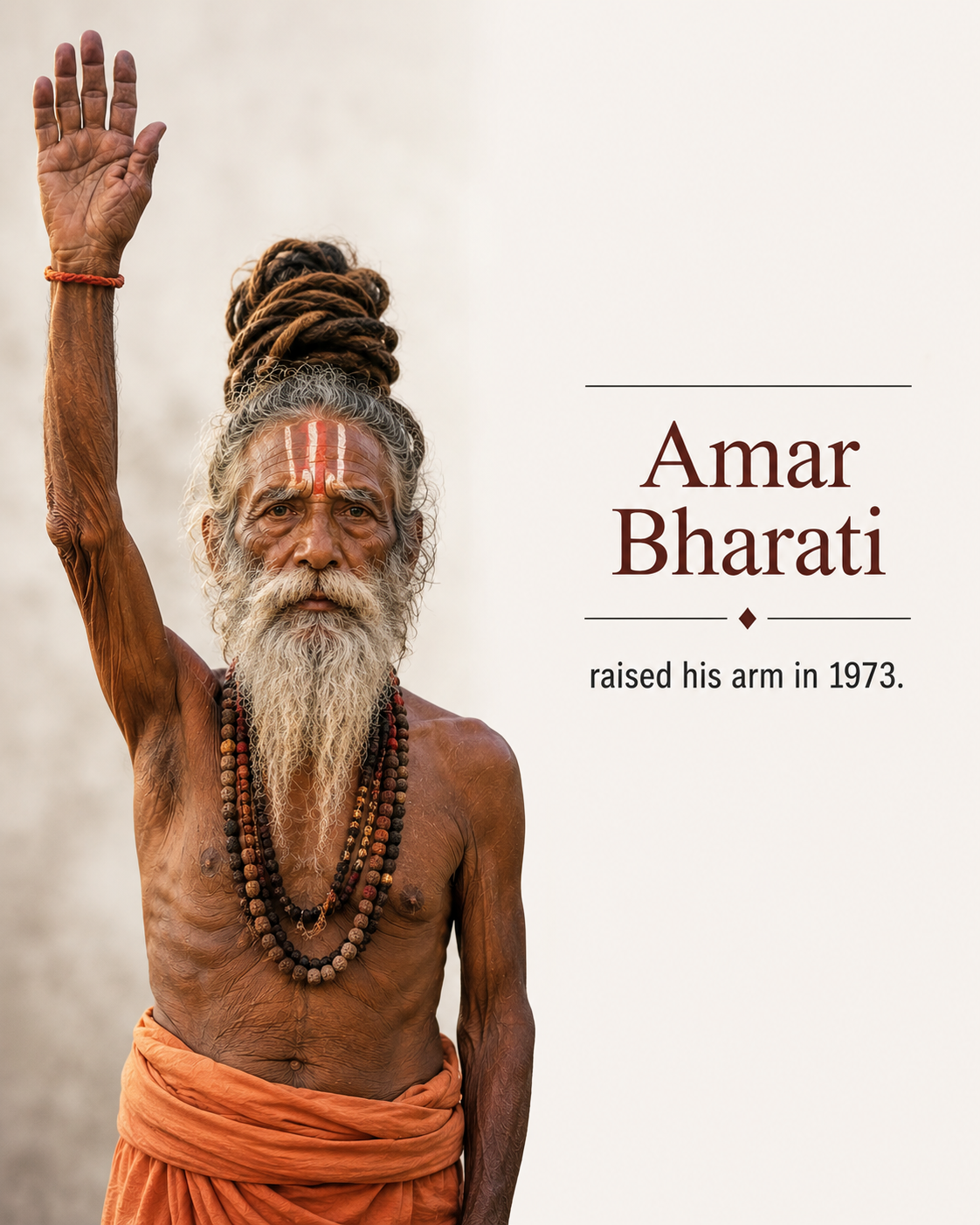
Depiction

A man named Amar Bharati became a Sadhu nearly fifty years ago. He left behind his family, career, and worldly possessions to dedicate himself to a spiritual life. At some point, he decided to demonstrate his devotion to Shiva by raising one arm above his head and keeping it there.

For the rest of his life. That was in 1973. Today, his arm remains permanently fixed in that position.

It's a remarkable demonstration of faith and dedication. It's also a remarkable demonstration of the body's ability to adapt. When a movement is abandoned long enough, the body eventually loses the ability to perform it.

This is one reason movement is so important. If you want to maintain the ability to push, pull, squat, hinge, carry, reach, climb, and play as you age, you must continue doing those things. Movement preserves movement.

But there is another lesson that becomes increasingly important as we get older.

"Use it or lose it" must never become "Abuse it and lose it."

Many fitness professionals preach full range of motion as if it were a sacred commandment. In an ideal world, perhaps it is. If a healthy twenty-year-old can comfortably move a joint through its entire range of motion, that's generally a good thing. The problem is that most of us aren't twenty years old anymore. Joints accumulate miles. Cartilage wears down. Arthritis develops. Old injuries leave their fingerprints behind. The body changes.

At some point, the question is no longer, "Can I perform the perfect exercise?" The question becomes, "How can I continue training safely for the next twenty years?" I learned this lesson the hard way.

When I was fifty years old, I was performing deep hack squats on a Smith machine. I had convinced myself that deeper was better and that full range of motion was always the correct answer. As I descended into one particularly deep squat, I felt and heard a sickening thud near my left hip and groin.

The pain was immediate and intense.

Being stubborn, I finished the repetition and reracked the weight. As I locked the bar in place, I felt another thud as my hip shifted back into position.

I had no idea there was anything wrong with my hip before that day. It took months to recover, and even now I can feel it when a storm rolls through town. If I get too ambitious with deep squats, it still reminds me of my mistake.

What I eventually learned is that there are certain joint positions that simply don't agree with my body anymore. Not because I have poor technique. Not because I'm weak. Not because I need a better warm-up. Because I'm over fifty-five years old.

For example, there are positions where my elbows hurt with almost no weight at all. Yet move them just a few degrees away from those positions and I can train hard, pain-free, and effectively. The same thing happens with my hips, knees, and shoulders.

Many people over forty-five discover the same thing. The answer isn't to stop exercising. The answer is to modify the exercise.

Today I often use slightly shorter ranges of motion than I did when I was younger. My squats stop a little higher. My deadlifts start from a slightly elevated position. Some pressing and pulling exercises are shortened just enough to keep my joints happy while still allowing me to train hard.

The goal is not to avoid movement. The goal is to preserve movement.

Whenever possible, use as much range of motion as you can comfortably tolerate. Learn the ideal movement pattern and strive toward it. But don't become so obsessed with perfection that you sacrifice longevity.

Pain is information.

If a movement consistently hurts, pay attention. Sometimes your body is telling you that a small modification would allow you to continue training productively for years to come.

Exercise should improve your life, not become a source of unnecessary wear and tear. As we age, movement remains essential. We still need strength. We still need muscle. We still need healthy bones, healthy joints, and healthy hearts. But wisdom becomes just as important as effort.

Move your body often. Move it in many different ways. Challenge it. Strengthen it. Preserve it. Just don't abuse it.

Because eventually, "Use it or lose it" can become "Abuse it and lose it."

And that's a lesson most of us only need to learn once.
Comment

Ch 31 - Excess Volume is the Enemy

Comment

Ch 31 - Excess Volume is the Enemy

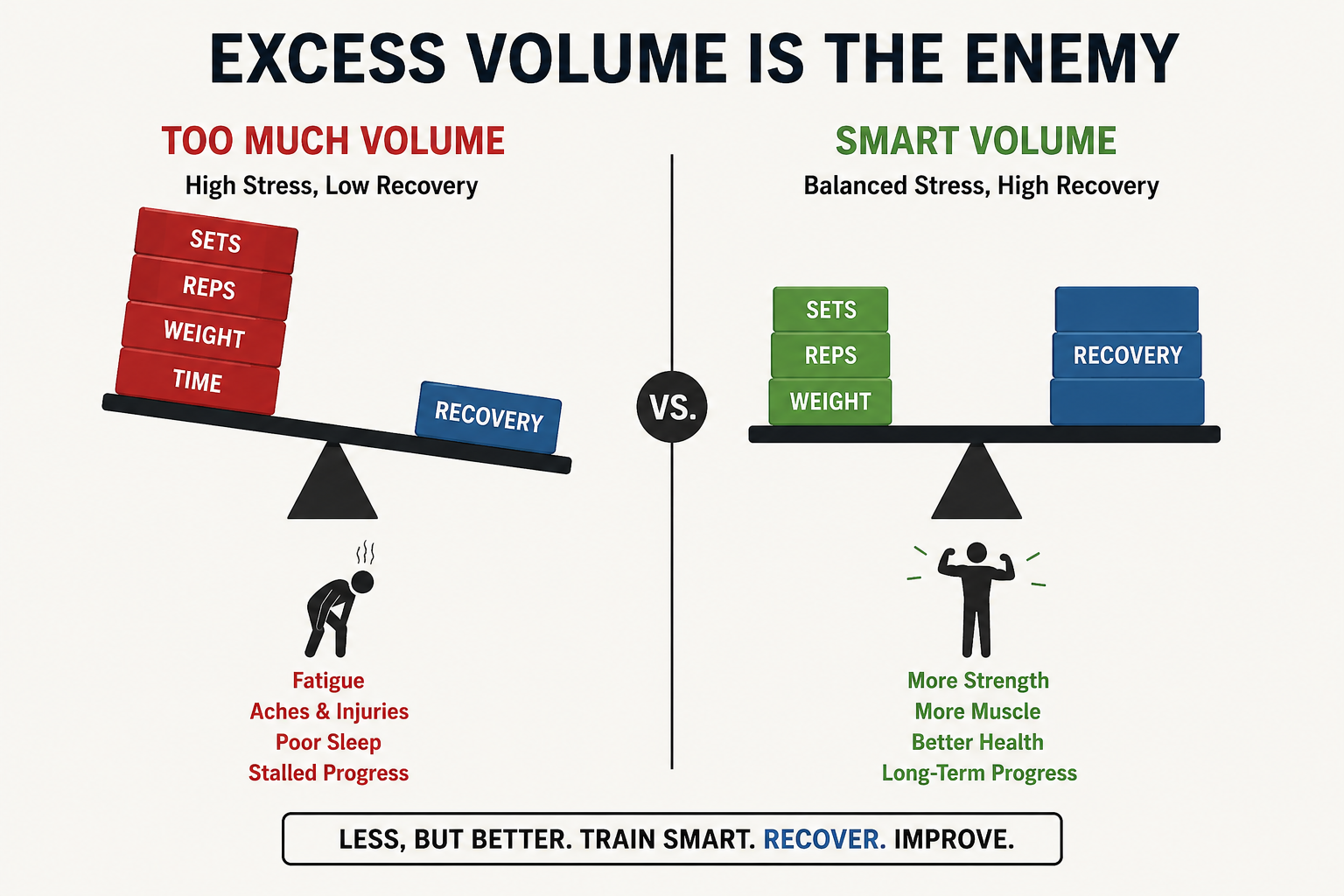
Volume refers to the total amount of physical work performed during a set, workout, or training program. In strength training, volume is often measured as sets × reps × weight. The greater the volume, the greater the stress placed upon the body. Stress is necessary for growth, but like medicine, the dose matters. Too little produces no effect. Too much produces harm. For those of us over 45, this distinction becomes increasingly important because while our ability to adapt remains impressive, our ability to recover is no longer unlimited.

There is an old belief in fitness that if some exercise is good, more exercise must be better. This idea has fueled countless high-volume training programs promising faster results through harder work. Unfortunately, after 40, the body often stops rewarding excess and starts demanding wisdom. The truth is simple: excess volume is the enemy.

When we were younger, our bodies tolerated almost any abuse we could imagine. We could sleep poorly, train six days per week, chase soreness, and pile on set after set with little consequence. Even poorly designed programs often produced results because youth itself is an extraordinary recovery tool. In our 40s, 50s, and beyond, that recovery reserve gradually shrinks. The body becomes less willing to forgive foolishness. Excessive training no longer creates fitness—it often creates fatigue, pain, and stagnation.

But this is not all bad news.

As the old Toby Keith song reminds us, "I ain't as good as I once was, but I'm as good once as I ever was." There is profound wisdom in those words. While we may not recover from endless training sessions like we once did, many older adults discover something surprising: they can often achieve remarkable results with much less work.

Over the years, my peers and I have repeatedly observed this phenomenon. Older lifters frequently gain strength and muscle using lower volumes than younger trainees. I personally have gained more muscle and strength in my fifties than at many earlier points in my life, including setting a lifetime bench press personal record at age 51. This seems counterintuitive, but it happens often enough that it cannot simply be dismissed as anecdote.

Why does this occur? Perhaps decades of movement create superior motor control. Perhaps muscle memory allows older adults to recruit muscle fibers more efficiently. Perhaps experience improves exercise execution and effort. Scientists continue to investigate these questions. Frankly, I care less about the exact mechanism than the outcome. The outcome is clear: many adults over 45 can achieve exceptional results with surprisingly little training volume.

This realization changes everything.

After 45, recovery becomes the currency of progress. Every unnecessary set is a withdrawal from your recovery account. Spend enough withdrawals without making deposits and eventually the bill comes due. It arrives disguised as sore joints, chronic fatigue, poor sleep, nagging injuries, or stalled progress. The goal is no longer to survive a workout. The goal is to recover from it and improve because of it.

When I program for adults over 45, the first thing I usually do is reduce volume. Then I increase quality. Fewer exercises. Fewer sets. Better technique. Heavier loads when appropriate. Longer rest periods. This approach consistently produces better results with less wear and tear.

I use the following guidelines when programming for strength 45+: 


Strength Training Guidelines 45+ 

  • 5 -10 sets per muscle group per week (lean more toward 5).

  • High volume is the enemy (V= sets x reps x weight)

  • Higher intensity is better 

  • Intensity is measured in weight 

  • Use 60-80 percent of 1RM for intensity

  • 5-8 reps per set. Stay on the lower side of this

  • Leave 2-3 Reps in Reserve (RIR)

  • Advanced routines using more than 8 sets and/or 8 reps should be limited to 6 wk training phases

  • This advanced phase may only be performed 1x/quarter

  • Exercise each muscle group 1x/wk unless doing an advanced routine 

  • Advanced routines using more than 6 sets/week should be limited to 6 wk training phases

  • This advanced phase may only be performed 1x/3 mo

  • Rest 2-5 minutes between each set or until completely recharged

  • Rest each muscle group, at least 48 hours after a workout


GPP Conditioning is a different thing


GPP Conditioning: 

  • Perform between 100-150 reps per movement patter (push, pull, squat, core) per week

  • Use light-ish weights 

  • Use RPE to measure intensity.

  • Never work above a 7 RPE

  • Exercise muscle groups 1-3x/wk

  • Rest as needed

  • Never red-line a workout. 


I know what many people are thinking: "This can't possibly be enough." After decades of believing that more is always better, reducing training volume can feel uncomfortable. It can even feel like laziness. But eventually age teaches us all the same lesson. The body no longer rewards punishment. It rewards wisdom.

At some point, every athlete learns an important truth: after 45, recovery is no longer the thing that happens after training.

Recovery is the training.

Comment

Ch 32 - The Subtle Art of Not Maxing Out

Comment

Ch 32 - The Subtle Art of Not Maxing Out

One of the biggest mistakes people make in the gym is believing that every workout should leave them exhausted. Somewhere along the way, we started confusing effort with effectiveness. We began treating soreness like a badge of honor and fatigue like proof of hard work. The fitness world often celebrates those who train until they collapse, but after 45, that mindset starts sending us an invoice.

Comment