
If you attend enough fitness conferences, you'll eventually hear experts arguing about the perfect warm-up.
One group advocates foam rollers. Another prefers dynamic mobility drills. Others insist on elaborate movement screens, activation exercises, corrective protocols, breathing techniques, stretching sequences, or highly specific routines that seem to take longer than the workout itself.
The problem is that nobody can agree on which warm-up is best.
For decades, warm-ups were believed to dramatically reduce the risk of injury during exercise. Yet despite thousands of studies and countless recommendations, researchers still struggle to identify a single superior method. Some approaches show modest benefits. Others show none at all. Most produce remarkably similar outcomes.
This mirrors what I've observed over more than three decades of coaching.
I've seen people spend twenty minutes meticulously warming up before suffering an injury during a relatively modest effort. We've also seen people walk into the gym, perform a few quick ramp-up sets, and complete enormous physical efforts without issue or injury.
This doesn't mean warm-ups are useless.
Far from it.
It simply means that many of the reasons people believe they need elaborate warm-up routines may not be as important as they think.
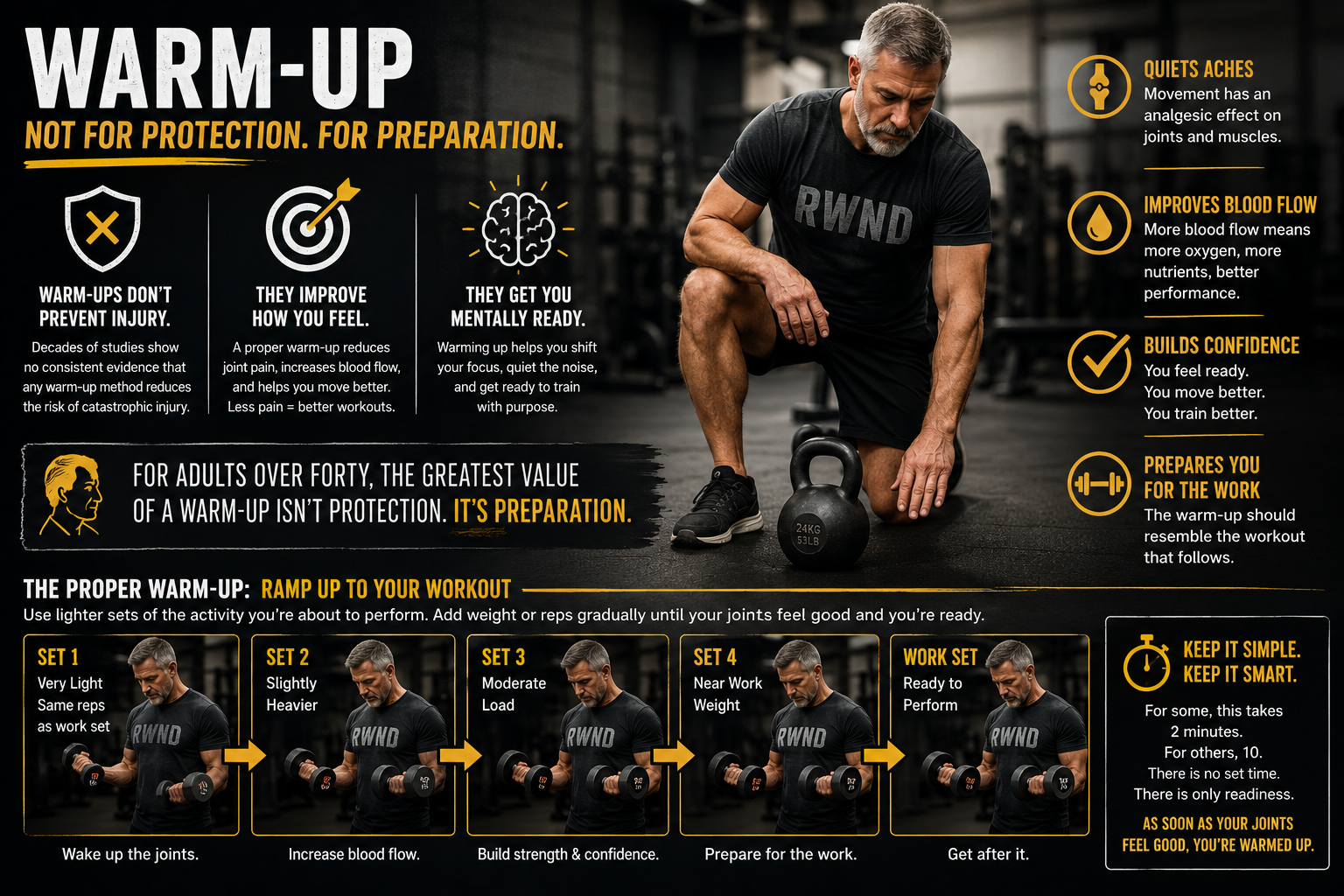
For adults over forty, the greatest value of a warm-up isn't protection. It's preparation.
Most of us arrive at the gym carrying something. A stiff shoulder. An achy knee. A cranky back. Tight hips. Sore feet. The accumulated mileage of a life well lived.
A good warm-up helps quiet those complaints.
Movement has a powerful analgesic effect. As blood flow increases and joints begin moving through comfortable ranges of motion, aches and pains often diminish. The body loosens up. The mind becomes focused. The workout becomes more productive.
That's why we warm up.
Not because we believe a magical sequence of exercises will make us injury-proof.
Not because we enjoy spending twenty minutes preparing for ten minutes of training.
We warm up because we feel better when we do.
And when we feel better, we train better.
The Proper Warm-Up
The solution to the warm-up question is remarkably simple.
Perform several lighter sets, rounds, or repetitions of the activity you're about to do.
If heavy biceps curls are scheduled, begin with a very light weight and perform the same movement. Add a little weight. Perform another set. Add a little more weight. Continue until your joints feel comfortable and your body feels ready.
That's it.
The warm-up should resemble the workout.
The warm-up should prepare you for the task ahead.
The warm-up should end the moment you feel ready.
For some people this takes two minutes. For others it takes ten or more. The goal is not to follow a complicated ritual. The goal is to arrive at the workout feeling comfortable, confident, and prepared.
As soon as your joints feel good and your movement feels smooth, your warm-up is complete.
Get after it.