The Four Cardinal Movements
Before we can discuss how to train the body, we must first understand how the body was designed to move.
Human beings are remarkably complex creatures, but our movement patterns are surprisingly simple. Nearly every physical task we perform can be reduced to four fundamental actions: we push, we pull, we squat and hinge, and we stabilize through the core. These are the Four Cardinal Movements.
Every time you stand from a chair, place a box on a shelf, carry groceries, pull open a door, climb a hill, pick up a child, or get yourself off the ground, you are using one or more of these movement patterns. Your body was built to do them. And therein lies an important truth: the fact that your body can do something is often a clue that it needs to do it.
A body capable of pulling needs to pull. A body capable of squatting needs to squat. A body capable of pushing needs to push. A body capable of stabilizing itself needs to challenge its core. Ignoring any of these movement patterns for long enough eventually creates a gap in your physical capability.
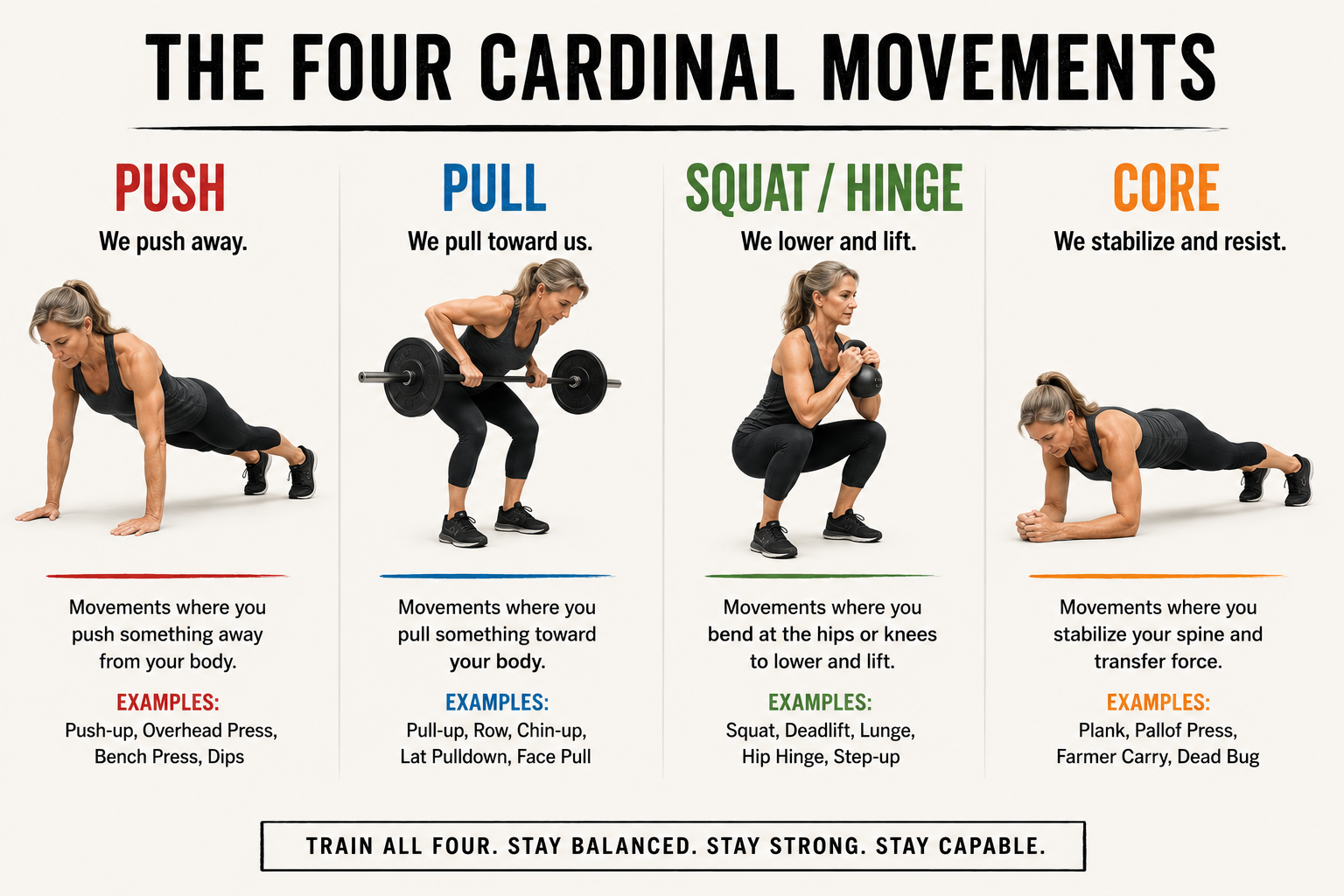
Pulling will never replace pushing. Pushing will never replace squatting. Core work will never replace conditioning. And no amount of running can replace the strength-building benefits of a properly performed squat, push, pull, and core training program. This is where many exercise programs fall short.
Runners often run but rarely lift. Cyclists pedal thousands of miles but seldom challenge their upper bodies. Yogis become wonderfully mobile but may neglect strength and conditioning. Weightlifters build tremendous strength while sometimes overlooking mobility and endurance. Each activity provides valuable benefits, but none provides all of them.
Health requires a broader approach.
The goal is not to become exceptional at one movement pattern while ignoring the others. The goal is to remain capable across all of them. The body thrives on variety, balance, and challenge. It was not designed to perform one movement repeatedly while neglecting all others. To become healthy, resilient, and physically capable, all four cardinal movements must be trained in balanced and comprehensive ways.
There may come a day when injury, age, pain, or limitation makes one of these movements difficult or impossible. If that happens, don't abandon the pattern altogether. Find the closest version your body will allow and continue practicing it. A partial squat is still a squat. An assisted pull is still a pull. A modified push is still a push. The body rewards effort far more than perfection.
Everything else in fitness is simply a variation on these themes. Master the Four Cardinal Movements and you will possess the foundation upon which nearly every aspect of health, fitness, strength, and physical independence is built.