
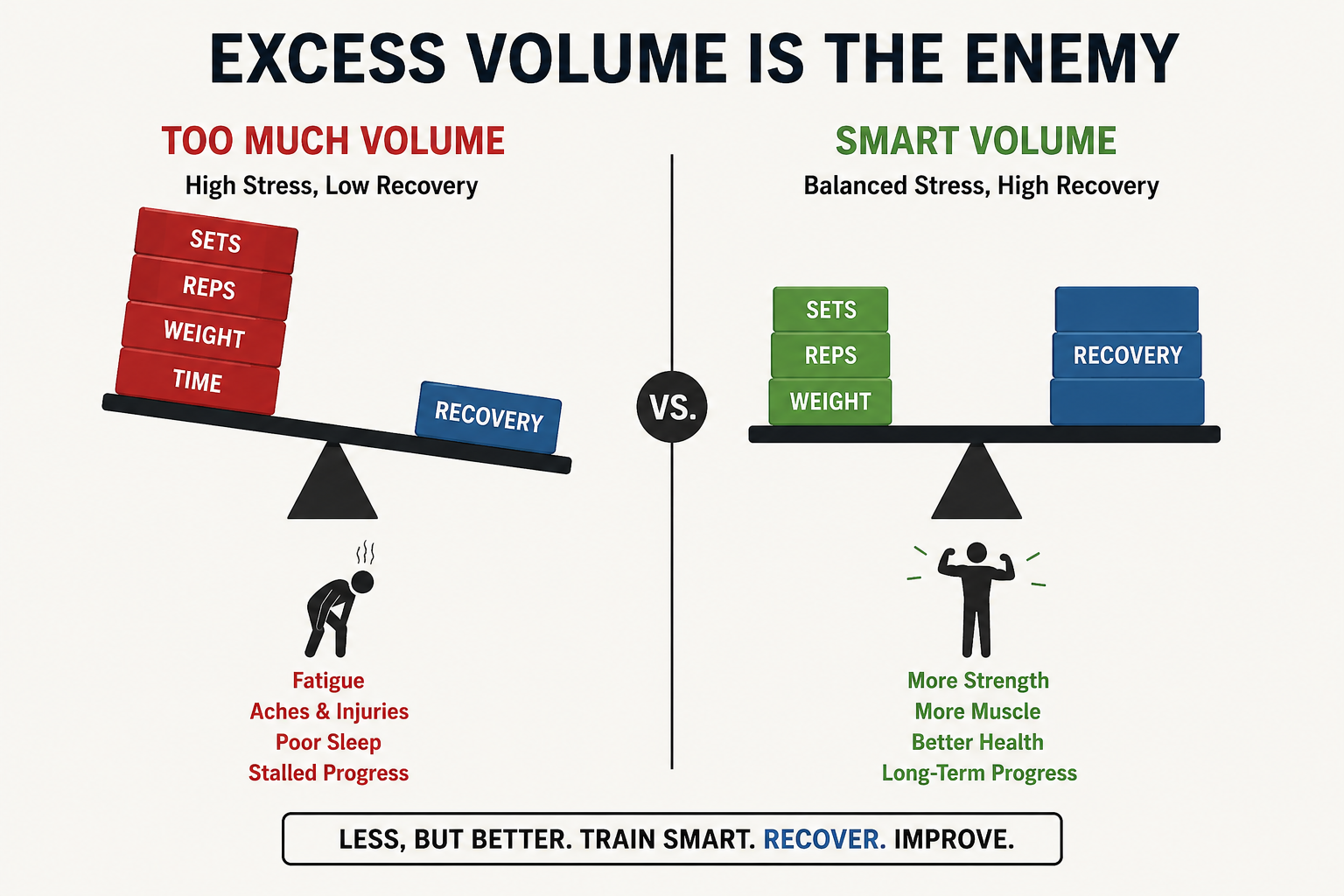
Volume refers to the total amount of physical work performed during a set, workout, or training program. In strength training, volume is often measured as sets × reps × weight. The greater the volume, the greater the stress placed upon the body. Stress is necessary for growth, but like medicine, the dose matters. Too little produces no effect. Too much produces harm. For those of us over 45, this distinction becomes increasingly important because while our ability to adapt remains impressive, our ability to recover is no longer unlimited.
There is an old belief in fitness that if some exercise is good, more exercise must be better. This idea has fueled countless high-volume training programs promising faster results through harder work. Unfortunately, after 40, the body often stops rewarding excess and starts demanding wisdom. The truth is simple: excess volume is the enemy.
When we were younger, our bodies tolerated almost any abuse we could imagine. We could sleep poorly, train six days per week, chase soreness, and pile on set after set with little consequence. Even poorly designed programs often produced results because youth itself is an extraordinary recovery tool. In our 40s, 50s, and beyond, that recovery reserve gradually shrinks. The body becomes less willing to forgive foolishness. Excessive training no longer creates fitness—it often creates fatigue, pain, and stagnation.
But this is not all bad news.
As the old Toby Keith song reminds us, "I ain't as good as I once was, but I'm as good once as I ever was." There is profound wisdom in those words. While we may not recover from endless training sessions like we once did, many older adults discover something surprising: they can often achieve remarkable results with much less work.
Over the years, my peers and I have repeatedly observed this phenomenon. Older lifters frequently gain strength and muscle using lower volumes than younger trainees. I personally have gained more muscle and strength in my fifties than at many earlier points in my life, including setting a lifetime bench press personal record at age 51. This seems counterintuitive, but it happens often enough that it cannot simply be dismissed as anecdote.
Why does this occur? Perhaps decades of movement create superior motor control. Perhaps muscle memory allows older adults to recruit muscle fibers more efficiently. Perhaps experience improves exercise execution and effort. Scientists continue to investigate these questions. Frankly, I care less about the exact mechanism than the outcome. The outcome is clear: many adults over 45 can achieve exceptional results with surprisingly little training volume.
This realization changes everything.
After 45, recovery becomes the currency of progress. Every unnecessary set is a withdrawal from your recovery account. Spend enough withdrawals without making deposits and eventually the bill comes due. It arrives disguised as sore joints, chronic fatigue, poor sleep, nagging injuries, or stalled progress. The goal is no longer to survive a workout. The goal is to recover from it and improve because of it.
When I program for adults over 45, the first thing I usually do is reduce volume. Then I increase quality. Fewer exercises. Fewer sets. Better technique. Heavier loads when appropriate. Longer rest periods. This approach consistently produces better results with less wear and tear.
I use the following guidelines when programming for strength 45+:
Strength Training Guidelines 45+
5 -10 sets per muscle group per week (lean more toward 5).
High volume is the enemy (V= sets x reps x weight)
Higher intensity is better
Intensity is measured in weight
Use 60-80 percent of 1RM for intensity
5-8 reps per set. Stay on the lower side of this
Leave 2-3 Reps in Reserve (RIR)
Advanced routines using more than 8 sets and/or 8 reps should be limited to 6 wk training phases
This advanced phase may only be performed 1x/quarter
Exercise each muscle group 1x/wk unless doing an advanced routine
Advanced routines using more than 6 sets/week should be limited to 6 wk training phases
This advanced phase may only be performed 1x/3 mo
Rest 2-5 minutes between each set or until completely recharged
Rest each muscle group, at least 48 hours after a workout
GPP Conditioning is a different thing
GPP Conditioning:
Perform between 100-150 reps per movement patter (push, pull, squat, core) per week
Use light-ish weights
Use RPE to measure intensity.
Never work above a 7 RPE
Exercise muscle groups 1-3x/wk
Rest as needed
Never red-line a workout.
I know what many people are thinking: "This can't possibly be enough." After decades of believing that more is always better, reducing training volume can feel uncomfortable. It can even feel like laziness. But eventually age teaches us all the same lesson. The body no longer rewards punishment. It rewards wisdom.
At some point, every athlete learns an important truth: after 45, recovery is no longer the thing that happens after training.
Recovery is the training.