Most people have heard the phrase, "Use it or lose it."
When it comes to the human body, that's largely true. If you stop using a movement, you'll gradually lose the ability to perform it. If you stop walking, walking becomes difficult. If you stop reaching overhead, reaching overhead becomes difficult. The body adapts to whatever you ask of it—and whatever you neglect.
A fascinating example of this comes from India.
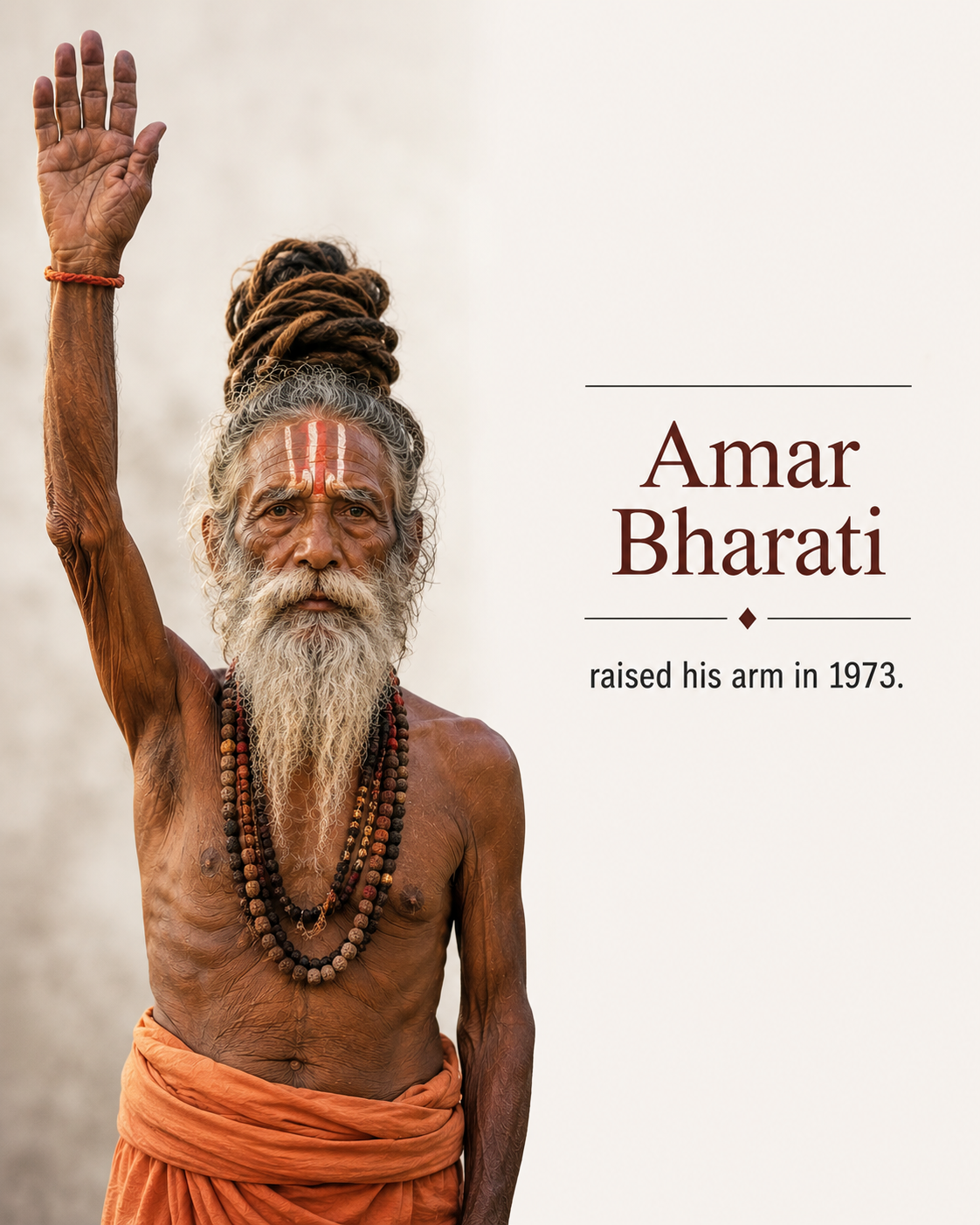
Depiction
A man named Amar Bharati became a Sadhu nearly fifty years ago. He left behind his family, career, and worldly possessions to dedicate himself to a spiritual life. At some point, he decided to demonstrate his devotion to Shiva by raising one arm above his head and keeping it there.
For the rest of his life. That was in 1973. Today, his arm remains permanently fixed in that position.
It's a remarkable demonstration of faith and dedication. It's also a remarkable demonstration of the body's ability to adapt. When a movement is abandoned long enough, the body eventually loses the ability to perform it.
This is one reason movement is so important. If you want to maintain the ability to push, pull, squat, hinge, carry, reach, climb, and play as you age, you must continue doing those things. Movement preserves movement.
But there is another lesson that becomes increasingly important as we get older.
"Use it or lose it" must never become "Abuse it and lose it."
Many fitness professionals preach full range of motion as if it were a sacred commandment. In an ideal world, perhaps it is. If a healthy twenty-year-old can comfortably move a joint through its entire range of motion, that's generally a good thing. The problem is that most of us aren't twenty years old anymore. Joints accumulate miles. Cartilage wears down. Arthritis develops. Old injuries leave their fingerprints behind. The body changes.
At some point, the question is no longer, "Can I perform the perfect exercise?" The question becomes, "How can I continue training safely for the next twenty years?" I learned this lesson the hard way.
When I was fifty years old, I was performing deep hack squats on a Smith machine. I had convinced myself that deeper was better and that full range of motion was always the correct answer. As I descended into one particularly deep squat, I felt and heard a sickening thud near my left hip and groin.
The pain was immediate and intense.
Being stubborn, I finished the repetition and reracked the weight. As I locked the bar in place, I felt another thud as my hip shifted back into position.
I had no idea there was anything wrong with my hip before that day. It took months to recover, and even now I can feel it when a storm rolls through town. If I get too ambitious with deep squats, it still reminds me of my mistake.
What I eventually learned is that there are certain joint positions that simply don't agree with my body anymore. Not because I have poor technique. Not because I'm weak. Not because I need a better warm-up. Because I'm over fifty-five years old.
For example, there are positions where my elbows hurt with almost no weight at all. Yet move them just a few degrees away from those positions and I can train hard, pain-free, and effectively. The same thing happens with my hips, knees, and shoulders.
Many people over forty-five discover the same thing. The answer isn't to stop exercising. The answer is to modify the exercise.
Today I often use slightly shorter ranges of motion than I did when I was younger. My squats stop a little higher. My deadlifts start from a slightly elevated position. Some pressing and pulling exercises are shortened just enough to keep my joints happy while still allowing me to train hard.
The goal is not to avoid movement. The goal is to preserve movement.
Whenever possible, use as much range of motion as you can comfortably tolerate. Learn the ideal movement pattern and strive toward it. But don't become so obsessed with perfection that you sacrifice longevity.
Pain is information.
If a movement consistently hurts, pay attention. Sometimes your body is telling you that a small modification would allow you to continue training productively for years to come.
Exercise should improve your life, not become a source of unnecessary wear and tear. As we age, movement remains essential. We still need strength. We still need muscle. We still need healthy bones, healthy joints, and healthy hearts. But wisdom becomes just as important as effort.
Move your body often. Move it in many different ways. Challenge it. Strengthen it. Preserve it. Just don't abuse it.
Because eventually, "Use it or lose it" can become "Abuse it and lose it."
And that's a lesson most of us only need to learn once.